Together With

👋 Happy Sunday, Best Ever readers!
In today’s newsletter, numbers lie, HUD says no, buyers buy, lenders split, warehouses run half full, and much more.
Today’s edition is presented by AI for CRE Collective. AI is moving fast across commercial real estate. The hard part is knowing where to start and which tools are worth your time. The AI for CRE Collective brings together 800+ brokers, investors, developers, owners, lenders, asset managers, and property managers using AI to underwrite deals, build BOVs and OMs, research markets, analyze sites, abstract leases, and automate repetitive work. Learn more.
🌟 The right room changes everything. Last week, Inner Circle members spent the day tackling real business challenges, sharing what's actually working in today's market, and building relationships that don't happen at a conference. See what you've been missing.
Let’s CRE!
🚧 Voucher Cliff: HUD has refused to distribute the $264 million Congress appropriated for replacement vouchers, leaving roughly 42,000 Emergency Housing Vouchers still in use without confirmed funding past December. One New York owner faces a $220,000 annual budget hole.
⏳ Deal Days: Buyers have accelerated Q4 acquisitions to capture up to 80% bonus depreciation before the benefit phases down after year's end, with cost segregation converting future deductions into near-term cash. Lenders still underwrite on NOI, which depreciation does not move.
🎭 Lender Split: Community bank Q2 results have diverged sharply on multifamily, with Merchants Bancorp growing net income 106% while Bank of California posted a $251.3 million loss and began selling $827 million in CRE and multifamily construction loans.
🌳 Suburban Surge: Suburban office values have climbed 3% YoY, the strongest gain of any major property type, while apartments posted a 10th consecutive month of annual declines at 1.7% and industrial slipped to a 0.4% YoY decline.
🪤 Rent Trap: Rent-stabilized properties have slipped into negative cash flow as expenses outrun capped revenue, with 484 New York multifamily properties and 601 in California now carrying DSCRs below 1.0x. One Brooklyn asset swung to negative $905,110 NOI.

The rent growth figure anchoring most investment committee memos traces back to a survey of roughly 7,000 households a month, each one contacted just twice a year, then run through a model built to smooth volatility across the entire economy. It was never designed to track what Class A and B apartments are actually leasing for.
Housing economist Jay Parsons has been pressing institutional owners to stop using CPI rent as a proxy for what's happening inside the properties they own. The index moves slowly by design, which means it lags turning points in rent growth and misses concessions entirely.
The Benchmark Problem: An asset tracking flat against national CPI rent inflation can be losing ground badly to its own submarket. RealPage data showing new-lease growth flat to negative in a Sun Belt submarket tells an operator something the national index never will, and the reverse holds too — modest gains during a private-data slowdown can be real outperformance.
What Lease Signers Actually Earn: Rent-to-income ratios have been drifting down across investment-grade properties because rents are growing more slowly than incomes for the households signing leases. John Burns research finds today's young adults carrying higher inflation-adjusted incomes than prior generations, even while delaying homeownership.
The Headroom Nobody Priced: A rent-versus-wages chart built on CPI overstates resident stress in exactly the segments institutional owners hold, and understates the room that exists for modest rent growth or repositioning.
The distinction matters more now that national rent growth has fallen below 2%, its lowest level in years, with Sun Belt deliveries pushing concessions higher and pressuring effective rents. Broad measures understate the damage in oversupplied submarkets while overstating pressure everywhere else.
Lenders have started tightening rent growth assumptions, which puts more weight on whether a sponsor can defend a 3% to 4% underwriting number with property-level evidence rather than a national series.
Pricing decisions made against a national inflation series are pricing decisions made against the wrong market. The operators who can show effective rents, trade-outs, and renewal spreads at the asset level will underwrite tighter numbers and defend them in front of lenders and LPs who are asking harder questions about where the assumptions came from. Everyone else is negotiating renewals against a series designed to move slowly.

Join 800+ CRE professionals using AI to underwrite deals, build BOVs and OMs, research markets, screen sites, abstract leases, review operating reports, and automate repetitive work with AI for CRE Collective.
Inside, you get:
✓ AI for CRE Certification and role tracks for every CRE seat
✓ 500+ hand-tested tools with member-only discounts
✓ 300+ workflows, 500+ prompts, and CRE AI skills
✓ Live workshops, monthly member huddles, and weekly office hours
✓ Advanced masterclasses, including the $599 Claude for CRE course
✓ A community sharing what works on active deals and assets
Start free for 7 days and get full access. Bring one task that is eating your time, find the workflow built for it, and use the community or office hours when you get stuck.
Underwrite a live deal, draft the BOV, abstract the lease, research the market, or automate the report before the trial ends.
Finish the Certification in your first 30 days. If you don't get your first win, we refund your entire first month. Cancel anytime.
START YOUR FREE 7 DAYS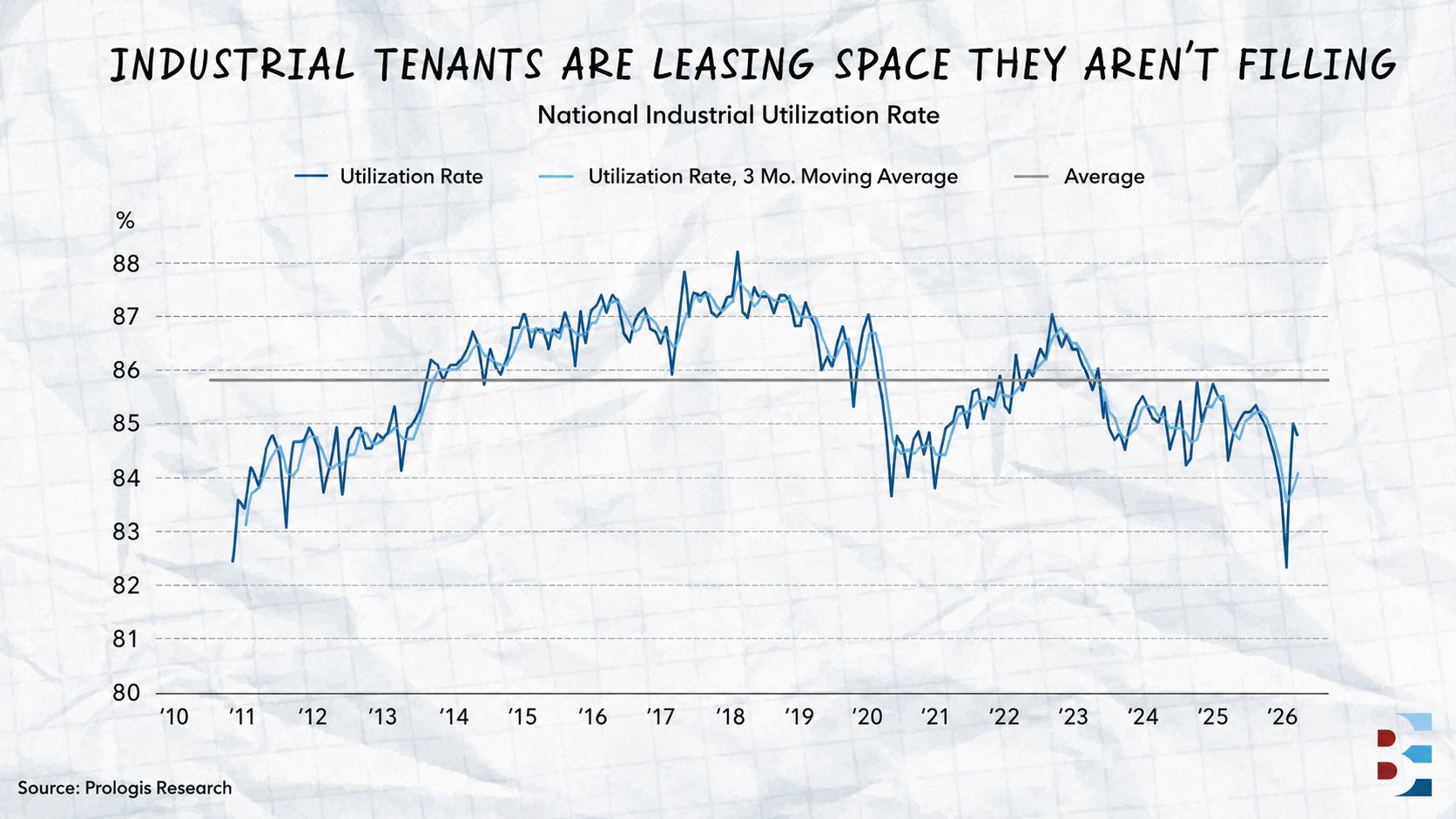
Warehouse leasing came back faster than warehouse usage. U.S. net absorption reached 66M SF in Q2, the strongest quarter since 2022, and rents climbed 70 bps QoQ as availability tightened. Utilization tells a slower story. The rate averaged 83% in Q2 and swung between 81.8% and 84.5%, leaving it below its long-run average for a third straight year.
The gap traces back to inventory discipline. Retail and wholesale inventories are sitting near historic lows relative to sales, with the inventory-to-sales ratio at 1.1 against an expansionary norm of 1.2 to 1.3. Restocking is happening, but it's concentrated in manufacturing and high-tech supply chains rather than spread across the consumer economy.
Securing Capacity, Not Filling It: Tenants signing leases against inventories they haven't rebuilt are buying optionality. That shifts the negotiation away from headline rent and toward term length, expansion rights, and the flexibility to grow into space over 18 to 24 months.
Expansion Demand Inside The Rent Roll: With utilization running four to five percentage points below where it peaked in 2018, the nearest growth in a portfolio is often a current tenant approaching capacity. Renewal conversations are worth starting well before the notice window.
The Cyclical Wild Card: Housing, autos, furnishings, and appliances have not recovered. Their return would push utilization up quickly. A prolonged flat stretch makes lightly used space the first square footage tenants hand back.
Prologis is telling occupiers to move early on large-format space, and the supply math supports it — market rents remain roughly 20% below replacement-cost levels, so little new construction pencils. For owners, the read is that pricing power is real, but the depth of tenant demand behind it has not been tested against a full restocking cycle.
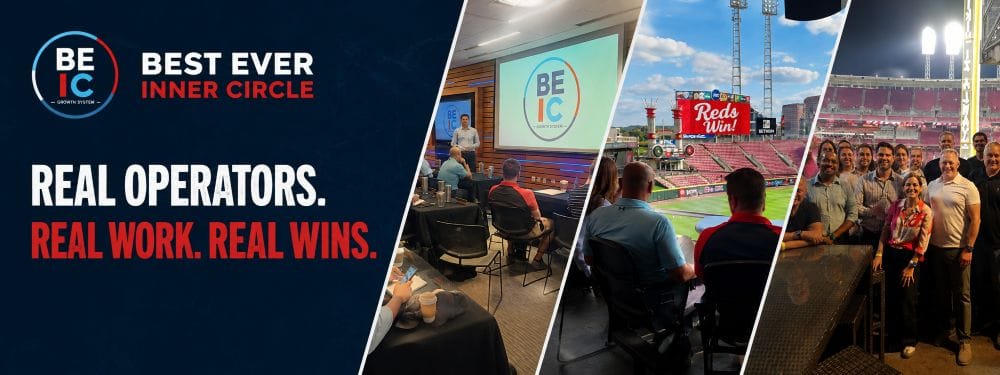
Last week, our Best Ever Inner Circle members spent the day together in Cincinnati.
There were no keynote speeches. No vendor pitches. No sitting in the back of a ballroom taking notes.
Instead, members rolled up their sleeves and worked on their businesses.
Here's a glimpse of what happened:
✅ Every member built a 2-Year Growth Roadmap complete with clear priorities and 30- and 60-day milestones to keep momentum long after the retreat.
✅ Joe unveiled several new benefits being released in the next 60 days:
LinkedIn Authority System to generate more investor leads
Personalized Distressed Deal Finder
AI-Powered Market Analysis Tools
✅ Members had an intimate lunch with Bob Castellini, founding partner of Sentinel Wealth Partners and part-owner of the Cincinnati Reds, discussing leadership, entrepreneurship, and building businesses that last.
✅ We wrapped up the day in a private suite at the Cincinnati Reds game, where we kept the fun rolling with a Reds win! Because sometimes the best conversations happen after the meeting ends.
The value isn't another conference.
It's having a room of experienced operators helping each other make better decisions, solve problems faster, and leave with a clear plan for what's next.
Want to join us at the next offsite? Members who join this month will lock in pricing for life AND receive a complimentary live webinar to the entire Best Ever community of 53,000+ investors and operators.
Book a quick intro call to see if the Inner Circle is the right fit.
BOOK YOUR INTRO CALL
Michael Rebelo raised nearly $2 million in under two years, and he did it before he turned 21. No track record, no rich friends, no network beyond his mother and grandparents. What he had was time and a phone he'd only owned since he was 16. At 18, when he decided to start raising capital, he was just three months out of high school and had to look up how to make an Instagram post.
The fund-to-funds model usually rewards people who arrive with a network already in place. Michael went the other direction, and the first six months returned nothing — no soft commitments, no calls booked, no measurable result from daily posting. This week on the Best Ever CRE Show, Michael joined Richard McGirr to break down the mechanics of building a capital-raising funnel from nothing.
The fix came from picking a target and writing to her. His mother, whose eroding retirement savings had started this whole thing at a kitchen table, had no idea what a vintage or an untrended yield on cost was. She was also exactly the investor he was trying to reach — a working American with savings, no financial advisor, and no exposure to private real estate.
Translate, Don't Impress: The early posts were written in operator language for an audience that doesn't speak it. Rewriting them around what a first-time passive investor actually wants — how the money works, how it's protected, what arrives quarterly — is when the engagement turned. "It's our job to kind of be the translator," Michael said.
Mind The DM Void: Likes and shares are vanity metrics. Inbound DMs are the number that ties back to capital, and the failure point is what happens after the first exchange. Leads that go quiet rarely come back. A spreadsheet with names and callback dates does the job until volume justifies a CRM.
Soft Commitments Flip The Leverage: Committed capital with nowhere to go changes who is doing the pitching. The search stops being a hunt for an allocation and becomes a screen on teams — full-cycle track record, capital call history, how conservative the underwriting actually runs. Anyone unwilling to answer those questions disqualifies themselves.
The results came in lumps rather than a curve — roughly $500,000 raised toward the CapEx on a $10.8 million deal, just shy of that on the second, and a $250,000 investor who surfaced from a single post. Richard's caveat still stands: this is the play when you have time and no network, and Michael had 18 months of both. Anyone with a Rolodex and a live deal should be dialing it.
👉 Listen to Michael’s full episode here.
🙏 Thanks for reading!
Stay in the loop with us! If you received this newsletter from someone else, subscribe here. You can also find us on LinkedIn, Instagram, and YouTube.
Have a Best Ever day!
— Joe Fairless