👋 Hello, Best Ever readers!
In today’s newsletter, preleasing numbers lie, El Niño looms, landlords unite, sale-leasebacks surge, luxury falls behind, and much more.
🔓 Introducing LP Lessons Unfiltered: Get the lessons experienced investors learned the hard way, then mingle with fellow LPs and seasoned CRE operators in an intimate, relationship-focused setting. Join us September 23 at 12pm ET.
⏰ We’re live today at 1 PM ET. Learn how Property Llama evaluates private real estate lending opportunities — and what you should look for before putting your capital to work. Register free →
Let’s CRE!
🌊 El Niño: Forecasters have put the odds of a very strong El Niño above 90% this fall and winter, with heavy December through February rain expected across the Southeast, Southern California, and the Gulf Coast, where insurance premiums already run high.
⚖️ Landlords Unite: More than 2,600 landlords have joined a federal lawsuit over the 2020-21 eviction moratorium, up more than 75% since spring. Settlement talks point toward roughly $1 billion after plaintiffs originally sought $26 billion in restitution.
🏙️ Zoning Plea: Frisco officials have asked to be exempted from SB 840, which allows apartments in commercial and warehouse zones without rezoning in Texas cities above 150,000 residents. The city created a heavy industrial designation to sidestep it.
🚢 Tariff Impact: Cross-border tariffs could shift industrial demand as companies onshore production and hold more inventory, though exposure varies. Maryland and Texas import tariff-affected goods at twice the North American average, but trade accounts for under 2% of each state's economy.
🏛️ Publicly Private: HUD has loosened Section 18 rules to draw private financing toward a $170 billion public housing capital needs backlog, widening obsolescence criteria, covering agencies with 75 or fewer units instead of 50, and opening mixed-finance properties once LIHTC periods expire.

Hundreds of freshmen at Cal State Long Beach started the semester in a hotel this fall, shuttling to campus while crews finished a delayed 424-bed dorm. About 2,000 miles east, Wisconsin-Oshkosh is tearing down three residence halls it no longer has students to fill.
Both scenes come out of the same shift, and it's the one deciding where student housing money goes now. The number of new U.S. high school graduates peaked around 3.9 million in 2025 and is projected to fall 13% to roughly 3.4 million by 2041. The same data shows 38 states with fewer graduates in 2041 than in 2023, with the Midwest and Northeast under the most pressure and the South holding up better than the country overall.
Investors have already adjusted. JLL data shows the 68 Power Four universities accounting for 82% of student housing beds delivering in 2025 and 2026. Scion Group and Ares Real Estate have put more than $1.3 billion into two portfolios this year, including 12 properties and 7,578 beds for roughly $910 million in May. Their September purchase covered four properties at Georgia, Tennessee, and Texas State for about $435 million, all large public universities that have expanded enrollment in recent years.
Preleasing across the Yardi 200 reached 89.1% in July, up from 88.1% a year earlier, and the spread underneath it is where the story sits. Twenty markets are effectively full at 99% preleased. Thirty-five sit below 80%, and 25 of those have dropped at least 10 percentage points from last year.
Supply Timing Beats Prestige: Walker & Dunlop's 2026 outlook puts Missouri, Penn State, Alabama, Auburn, Texas, and Oklahoma among the sector's stronger markets, with Texas A&M, Florida State, Central Florida, Arizona State, North Carolina State, and Michigan facing heavier pipelines. A university can keep adding students while the housing market around it goes temporarily overbuilt.
Rent Growth Has Gone Regional: Northeast rents rose 3% YoY in July to $1,039 per bed, and Midwest rents rose 2.5% to $873. The West carries the highest rents at $1,094 but has managed 0.1% growth this leasing season.
Growth Without Supply Draws Developers: Landmark Properties and Paceline Equity Partners are building a 656-bed complex near Kennesaw State, where record enrollment has met nearly five years without new purpose-built supply. It opens for the 2028-29 academic year.
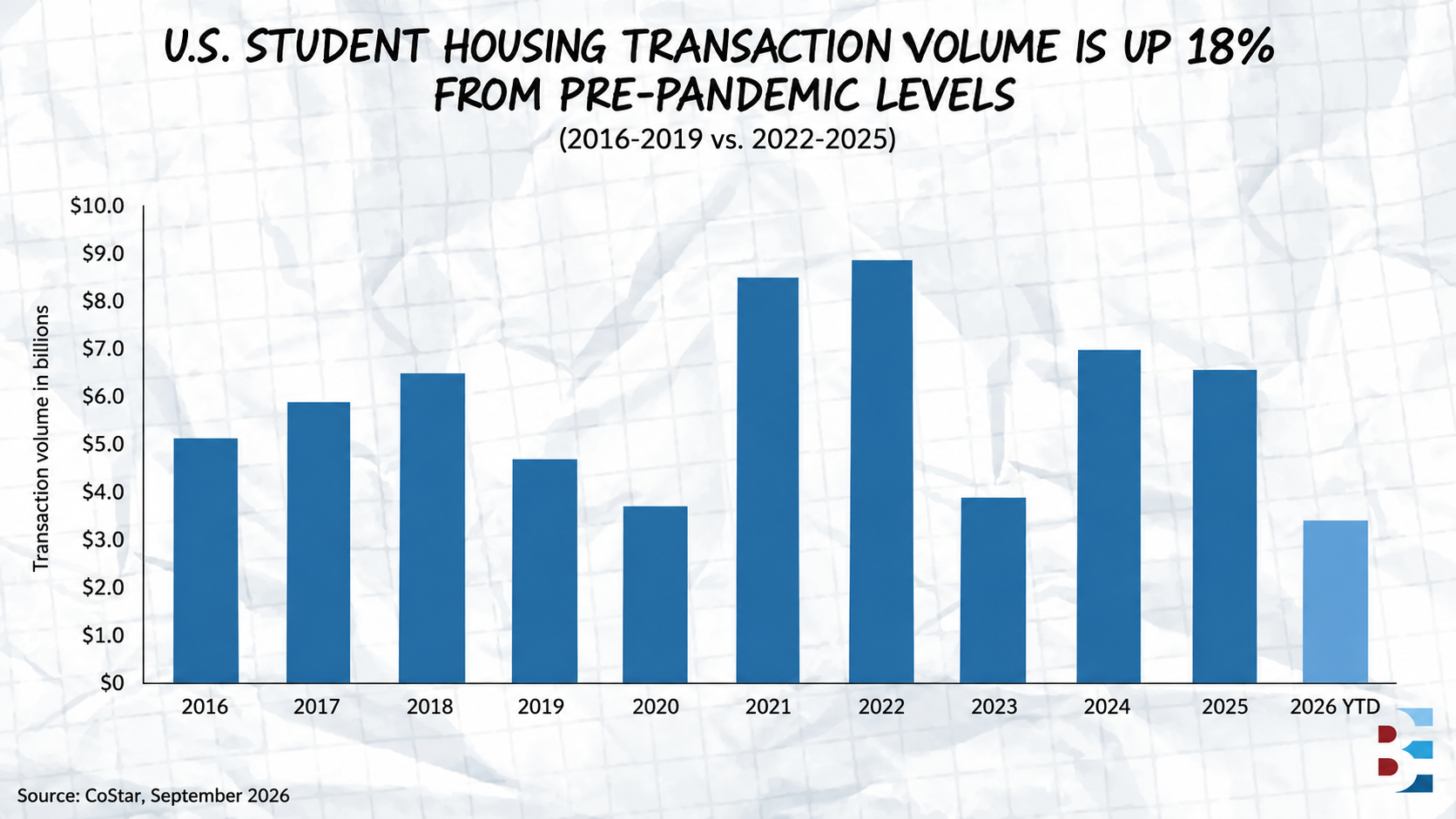
Transaction volume reached $6.3 billion over the past year, up about 40% from the 2023 trough. National asking rents held near flat at $938 per bed in Q3 to date, with effective rents easing to $925 from $928. Walker & Dunlop's outlook points to slowing construction starts improving the supply picture over the medium term, and to owners increasingly turning to recapitalizations and structured liquidity rather than selling outright. For operators holding beds at a school with a thin pipeline, that combination buys time.
The demographic squeeze arrives slowly enough that operators can still pick their spots, and the two variables that matter most at any given school are enrollment trajectory and how many competing beds are already under construction nearby.

We’re launching a new kind of event for passive investors.
On September 23 at 12 PM ET, we’re bringing together a select group of accredited LPs and experienced CRE operators for an hour built around real investing lessons and real relationships.
First, Joe Fairless sits down with Paul Shannon, author of Both Sides of the Table and an LP in 40+ real estate deals, for a candid conversation about what actually happens after you invest: the wins, the losses, the red flags he missed, and what he does differently with his money today.
Then, the mixer begins.
You’ll break into small groups with other accredited LPs and experienced operators from the Best Ever Inner Circle, giving you the chance to ask questions, compare perspectives, learn what others are seeing in the market, and build relationships with people actively investing and operating in CRE.
No sitting through an hour-long presentation. Half lessons. Half connections.
Live attendance is limited to 25 accredited passive investors.
RSVP TO JOIN
We’re going live today at 1 PM ET.
Property Llama co-founders Richard McGirr and Chris Lopez are joining us to break down how they evaluate private real estate lending opportunities, drawing from $40M+ in private lending partnerships and 100+ loans.
You’ll learn what to look for beyond LTV, how to assess the strength of a loan portfolio, why an operator’s track record matters, and what may actually be protecting your principal when you invest.
If private lending is already part of your strategy, or you’re considering it, there’s still time to join us.
Can’t make it live? Register anyway, and we’ll send you the replay.
SAVE YOUR SEAT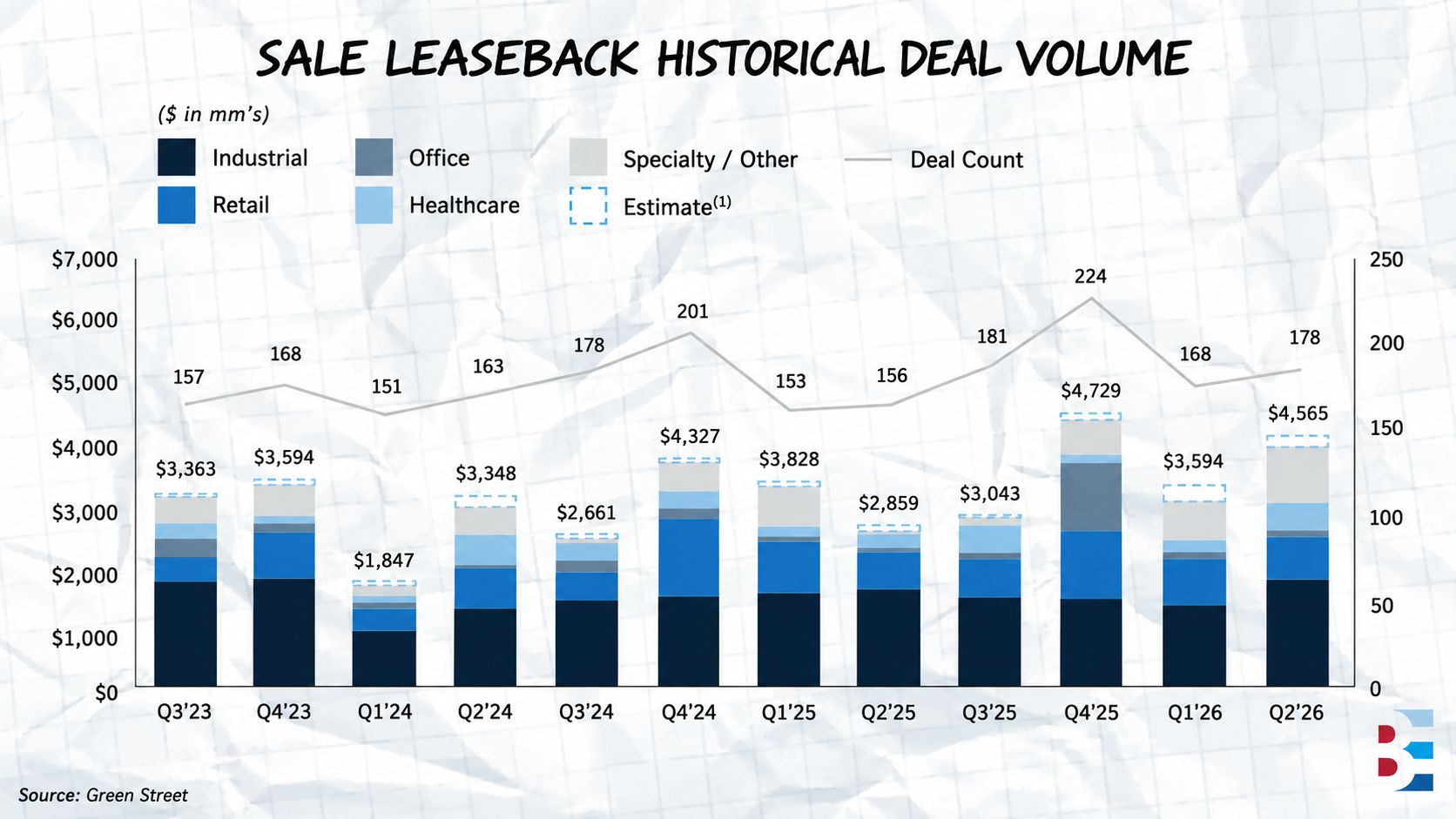
Sale-leaseback volume reached $4.6 billion in Q2, up roughly 27% QoQ and the strongest half-year start since 2022. Large portfolio sales drove the dollar figure, led by VICI's $1.1 billion purchase of a Golden Entertainment casino and hotel portfolio and W.P. Carey's $400 million pickup of a GardenCore portfolio.
Industrial Leads Count: Industrial accounted for 42% of the quarter's 178 transactions, the largest share by count, while retail slipped three percentage points QoQ to 39%.
New luxury store openings in the U.S. fell 46% YoY in the first half of 2026, totaling 123,334 SF against 227,000 SF a year earlier. Brands are trading door count for flagship scale, with monobrand openings running below 2022 levels and average flagship size up more than 30%.
Population growth slowed or turned negative in 86 of the nation's 92 largest cities in 2024-25, with 56 growing more slowly, 24 flipping from growth to decline, and six posting deeper losses. Growth across the group fell from 1.13% to 0.31%, and cities losing population rose from eight to 32.
City-Suburb Split: Primary cities in 40 of the 56 major metros slowed more sharply than their suburbs, reversing the city-led growth pattern that held the year before.
Mortgage rates on the 30-year average reached 6.66% in late August, against 6.56% a year earlier and 2.67% in December 2020. Buying a home now runs about 50% more expensive than renting one, and monthly payments on the median home have roughly doubled from pre-2020 levels.

The land flip used to be one of the fastest trades in real estate. Buy from a seller who doesn't know what they have, clear a lot or drop in a well, and exit at roughly double inside three or four months. That math stopped working in 2022.
On a recent episode of the Best Ever CRE Show, Chris Duff joined Ash and Amanda to explain what the rate environment did to land. Duff and his partners came in as the capital behind a Florida operator, spun up their own shop, then moved entirely into funding other people's deals.
Exits Take Twice As Long: Duff still reverse-engineers deals for a sub-90-day hold, but since mid-2022 he plans for six months or more, often with multiple price cuts along the way. His response has been to build bigger discounts into the buy.
Equity Beats Debt On Land: Debt lenders in the space are getting 8% to 15% and betting on the operator. Duff funds through equity instead, takes title, controls the listing agreement, and asks for 30% to 50% of the profit.
Price Per Acre Falls Apart Below Three Acres: A two-acre parcel usually sells for close to what a one-acre parcel does, because a builder can only put one house on either. Infill is his most cautious category for a different reason: one use case, no way to subdivide, no outs if the buy price is wrong.
AI has pulled more competition into land than the asset class has ever seen, and Duff has spent two-plus years trying to automate underwriting for it. County-level pricing and a floodplain overlay don't tell an operator whether a parcel's comps hold up. That work still runs parcel by parcel, and it's the part that decides whether the deal clears.
👉 Listen to the full episode here.
🙏 Thanks for reading!
Stay in the loop with us! If you received this newsletter from someone else, subscribe here. You can also find us on LinkedIn, Instagram, and YouTube.
Have a Best Ever day!
— Joe Fairless