👋 Hello, Best Ever readers!
In today’s newsletter, shadow lenders drive the private credit boom, warehouses burn, hotels win the World Cup, student housing fills up, and much more.
🌟 Every business challenge has a solution. You just need the right system. From raising capital and finding distressed deals to pressure-testing underwriting and solving operational bottlenecks, we've built a complete Growth System designed to help experienced CRE operators move faster. See what's inside.
🎓 What if your returns had nothing to do with the market? On Thursday, July 23, at 1 pm ET, Ironton Capital's Lon Welsh breaks down medical receivables, the asset class quietly generating 11–13% annual returns for over a decade, regardless of what stocks or real estate are doing. Claim your spot.
Let’s CRE!
🏘️ ROAD Rebuttal: Six major housing groups have pressed the U.S. Treasury to confirm build-to-rent communities are exempt from the new ban on institutional single-family rental purchases, warning the ambiguity has frozen BTR investment.
💵 $10 Billion Hold: The Fed has kept reserve management purchases at $10 billion through August 13 even as Treasury bill supply climbs, a liquidity balancing act that could lift funding costs and CRE financing rates.
🛒 Bankruptcy Wave: U.S. bankruptcy filings have climbed nearly 12% YoY to 591,850, pushing retail and restaurant tenants into Chapter 11 restructurings where they can shed underperforming leases and force landlords into rent concessions.
🔥 Industrial Risk: Warehouse fires have grown larger and costlier as buildings scale up, averaging $200 million in annual damage, while leasing for 500,000 SF sites jumped 31% YoY in 2025 and cold storage keeps expanding.
🏭 Ohio Rising: Ohio has topped CNBC's Top States for Business rankings for the first time, drawing manufacturing and data center capital with low costs, shovel-ready sites, and 143 million people within a day's drive.
The bank behind your next CRE loan may never appear on a single document you sign. As traditional lenders pulled back under damaged balance sheets and tighter capital rules, many reached a quiet conclusion: if they couldn't out-lend private credit, they could bankroll it and collect a spread instead.
The result is a fast-growing web of hidden relationships that has turned rivals into silent partners. Private credit firms held about $1.4 trillion in loans in the second half of 2025, roughly 10% of all U.S. nonfinancial corporate debt and nearly double their 2021 level. Bank commitments to nonbank financial entities hit $2.6 trillion by year-end, up from $1.2 trillion in 2018.
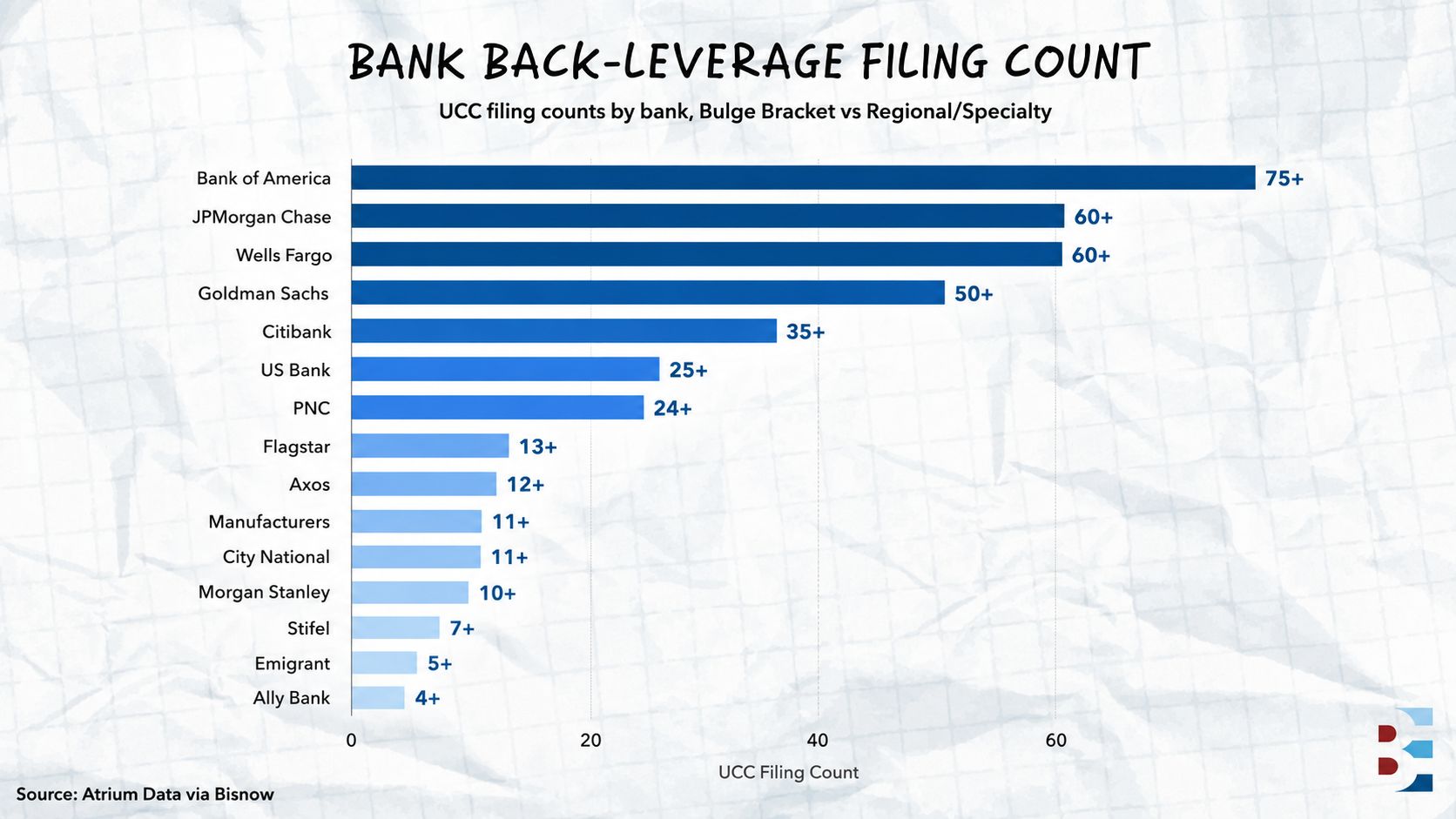
The tangle is deliberate. A loan can trace back to a marquee bank, yet the institution supplying the leverage never appears on the borrower's loan documents or in any property record. One dataset from Atrium Data mapped the web through Delaware UCC filings, and each major bank runs its own playbook.
Big Banks' Split Strategies: Goldman Sachs casts the widest net, with more than 50 filings tied to nine private credit operators. Bank of America concentrates on TPG Real Estate and Blackstone, JPMorgan sends 40 filings to Sculptor Capital entities, and Citi leans on Apollo's Athene.
The Aggressive Outlier: Axos Financial, a $28 billion San Diego digital bank, runs the most concentrated back-leverage book of its size — at least 30 alternative asset managers, from Carlyle and Blue Owl to smaller shops. It built its name backing sponsors other lenders refused to touch.
The Basel Engine: Financing a lender rather than a building counts as a commercial and industrial loan, which carries a lighter capital charge under Basel III, so banks keep their real estate exposure while shifting it to a friendlier corner of the balance sheet.
The roles blur as the money moves, with private equity firms, asset managers, and insurers now sitting on both sides, lender and borrower, and cheaper leverage has lenders fielding calls from banks angling to grow it. What's harder to see is where the risk settles.
As more CRE lending drifts outside the banking system, the risk spreads into a web that's tougher to price and trace. For anyone underwriting a deal or allocating into a credit fund next cycle, the question is whose balance sheet stands behind the loan, because much of that capital traces back to everyday investors who don't know they're in the chain.

When we launched the Best Ever Inner Circle, our goal was simple: create a room where experienced operators could solve real business challenges together.
Today, it's grown into a complete Growth System designed around the five biggest challenges commercial real estate operators face.
💰 Need to Raise More Capital?
Present your next deal to a curated group of active fund managers, learn proven family office and RIA strategies, and access resources like the Fund Manager Fast Track course to strengthen your capital-raising process.
🔎 Need Better Deal Flow?
Get customized distressed multifamily opportunities in your target markets, access a nationwide directory of 300+ multifamily brokers, and learn what's working from operators actively buying today.
📈 Need to Strengthen Your Operations?
Bring your toughest challenges to weekly strategy sessions, dive deep in your 1-on-1 strategy call with Joe Fairless, tap into our in-house CRE securities attorney, and learn directly from guest experts and implementation partners.
🛡️ Need More Confidence Before Making a Decision?
Pressure-test your underwriting before investors see it, receive independent deal reviews, evaluate sponsors with background reports, and get real-time feedback from experienced operators.
🤝 Need Better Relationships?
Stay connected year-round with serious operators through our private community, attend exclusive member retreats and Best Ever events, and build relationships that lead to more deals, more capital, and faster solutions.
This is NOT a mastermind.
It's a Growth System built to help experienced commercial real estate operators raise more capital, find better opportunities, strengthen their businesses, and make smarter decisions.
EXPLORE THE INNER CIRCLE GROWTH SYSTEM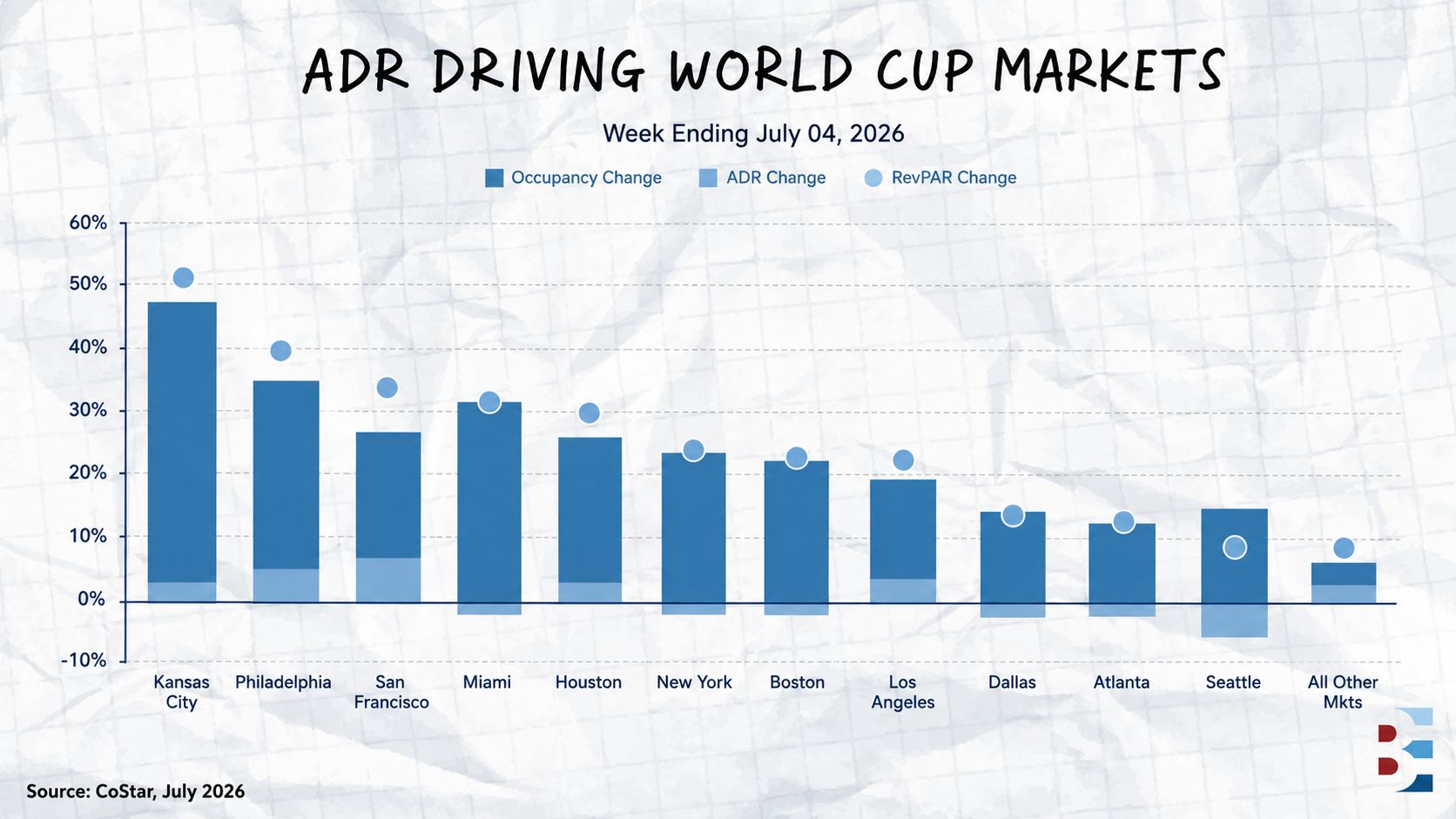
Average daily rate in World Cup host markets ran about 21% above last year in the week ending July 4, pushing RevPAR up 23%. Higher room rates have powered the tournament's hotel gains from the start, though host-market occupancy finally turned positive for the first time.
National effective apartment rents are projected to rise just 1.9% over the coming year, according to RealPage, as energy-driven inflation and slower job growth cool demand. Only San Francisco, Milwaukee, and Miami are expected to clear 3%, while oversupplied Sun Belt metros like Austin and Houston could go flat or negative.
Supply Slows: Developers plan just 312,000 new units over the next four quarters, with Dallas leading the country at nearly 19,000 underway.
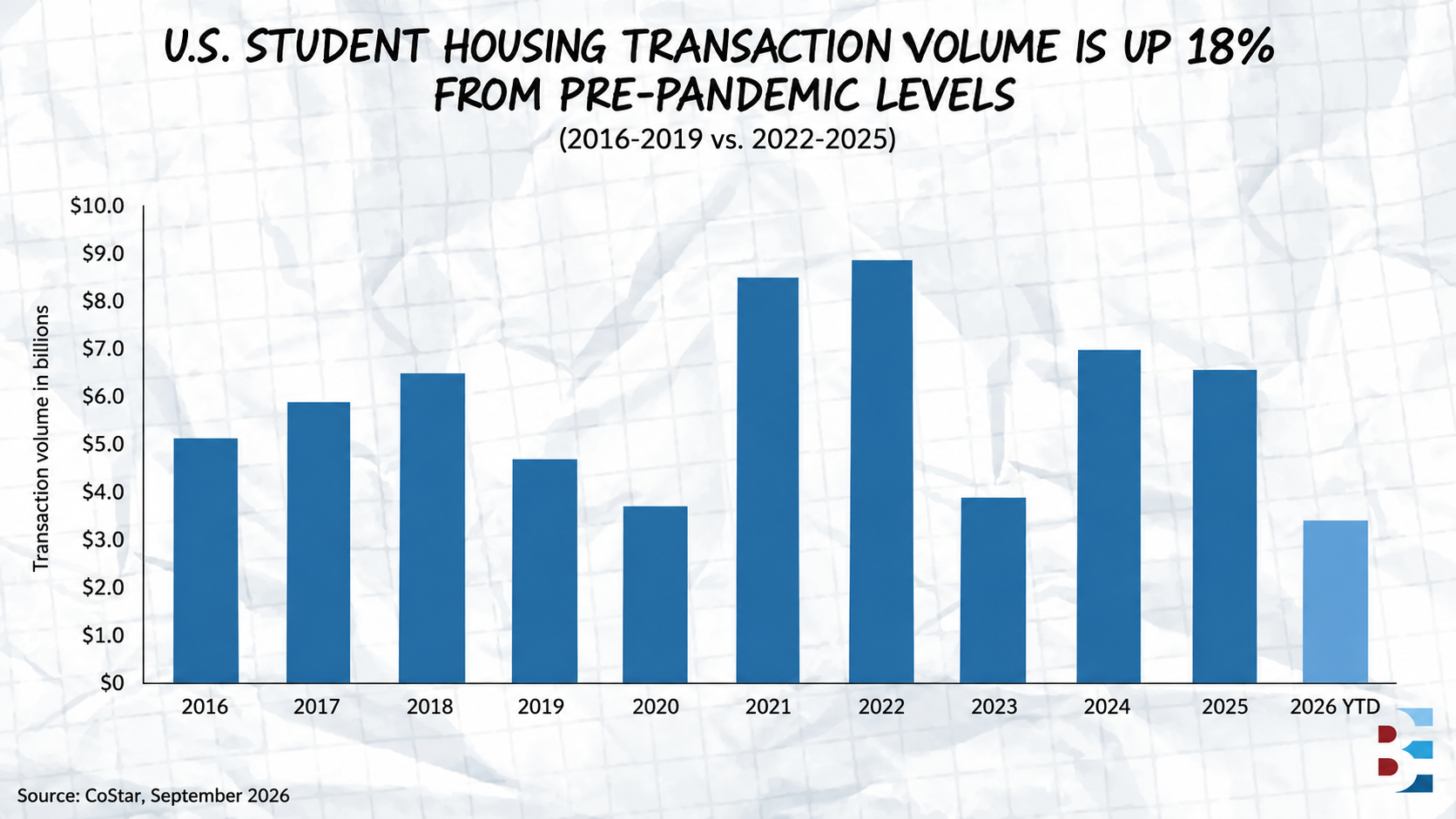
Student housing was 84.7% pre-leased for the Fall 2026 season as of June, according to RealPage, running 340 bps ahead of the 10-year average and matching last year's pace. Demand has now topped seasonal norms for four straight months, setting up another healthy leasing year for the sector.
Office vacancy fell in 49 of 92 major U.S. markets last quarter, a second straight quarter of improvement as steady leasing and a wave of conversions pulled obsolete space off the board — national office inventory has shrunk 33M SF over five quarters.
Leading Signal: Available sublease space fell 15% YoY to 96M SF, its lowest level since early 2021 and often a precursor to broader office recovery.
Construction input prices slipped 1.1% in June as oil prices tumbled, with crude petroleum down 12.1% on the month. The relief looks temporary — they still run 7.6% higher than a year ago, and a renewed Iran conflict has already pushed oil back up roughly 15%.

While most alternative investments still move with the market in some way, medical receivables operate on an entirely different set of rules.
Returns don't come from stock prices, real estate valuations, or investor sentiment. They come from insurance reimbursements — payments that insurance companies are legally required to make. When markets swing, the medical bills keep getting paid.
In this free webinar, Ironton Capital's Lon Welsh breaks down exactly how this asset class works, why it has quietly generated 11–13% annual returns for over a decade, and what investors should evaluate before adding it to their portfolio.
You'll walk away knowing:
📌 How medical receivables generate consistent returns regardless of market conditions
📌 Why the return profile is more predictable than most alternatives
📌 What downside protection actually looks like in this asset class
📌 How to evaluate whether it belongs in your portfolio
📅 Thursday, July 23 at 1 pm ET
SAVE YOUR SPOT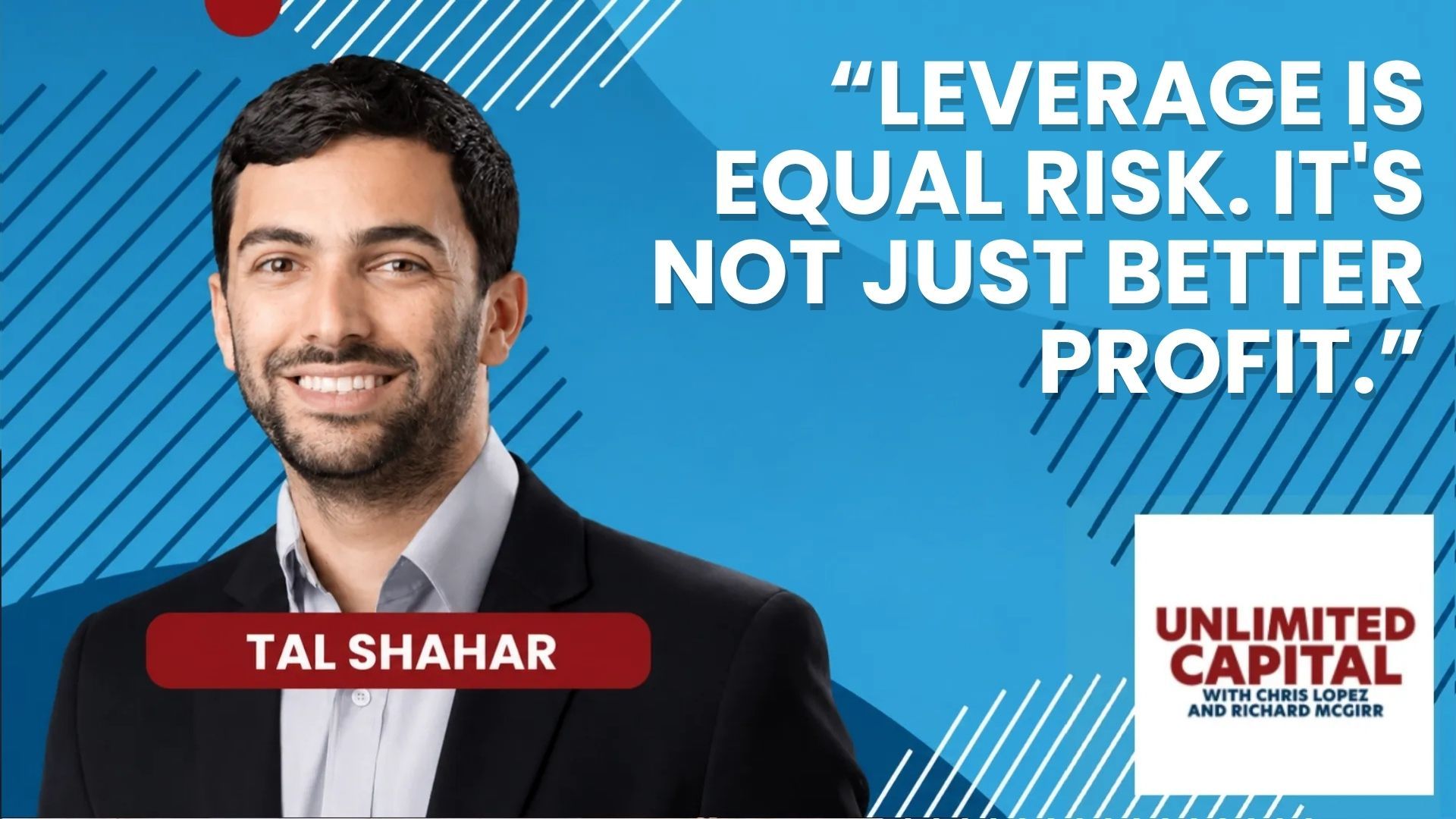
Fast money often beats cheap money. So for a sponsor chasing a hard closing date, the gap between a term sheet in a day and financing in a month is the whole ballgame.
This week on the Best Ever CRE Show, Tal Shahar, a commercial bridge lender, joined Richard McGirr and described a recent deal: a seasoned operator, millions in projects behind him, came through a broker for a condo construction-completion loan and didn't buy the pitch.
As Tal tells it:
A few months ago, we had a very experienced real estate owner — he's done millions of dollars of projects — come to us through a broker who'd already closed a couple of deals with us. And he was in disbelief. He said, ‘Listen, I know this market very well. You're promising same-day term sheet, same-week financing. I don't believe you, but I don't have a better choice. So let's try. Let's see what you've got.’
He got the same-day term sheet. And he needed to close the deal in less than four days. He got the financing in less than four days. He was amazed. He got to a point where he said, ‘Listen, I actually didn't believe you guys could perform and deliver. I have a lot of other business I can do with you, and I'm going to tell all my friends.’
That loan was about $3.5 million. A couple of months later, he closed another $3.5 million with us, and he was amazed all over again at the speed and simplicity.
So how does Tal work so quickly when a bank takes months? His firm built its own AI underwriting system in-house — not one model, but a set of specialized agents that each handle a piece of the deal:
It Reads the Property: One agent pulls the address and "drives" the block on Google Maps, while others scrape listing photos for a recent renovation or a problem an analyst would catch on-site, then run the same read across every nearby comp to flag matches that aren't really comparable.
It Cross-Checks Itself: Different models handle different tasks, sometimes two in parallel to validate each other, with plain algorithms used where AI isn't needed — pulling dozens of data sources into a full underwriting report in minutes.
It Knows What It Doesn't Know: A governance layer scores its own confidence and flags anything below 90% certainty for a human to verify, so speed doesn't curdle into blind trust in a model.
Tal is candid about the limits: miss a document and the clock slips. But he holds loan-to-value at 70% to 75% and prices around 10% to 11%, his guard against the real risk of overleveraging a borrower. When a deal has a hard date, the sponsors who win are the ones who lined up a fast lender before they needed one, and who read the structure closely, because speed at 90% leverage is how the exit disappears.
👉 Listen to Tal’s full episode here.
🙏 Thanks for reading!
Stay in the loop with us! If you received this newsletter from someone else, subscribe here. You can also find us on LinkedIn, Instagram, and YouTube.
Have a Best Ever day!
— Joe Fairless