Together With

👋 Hello, Best Ever readers!
In today’s newsletter, the Midwest recovers, the Fed shifts, a mega-merger rattles CRE, industrial and office level, and much more.
Today’s edition is presented by QC Capital. QC Capital is targeting up to 12% returns by applying institutional-grade underwriting to express car wash operations — membership-driven, automated, and built for scale. Learn more.
🌟 Inner Circle members are workshopping deals, structuring rescue financing, and raising capital — and meeting in person August 4 in Cincinnati. Now is a great time to join! Learn more about the group.
Let’s CRE!
📈 Neutral Zone: The Fed's shifting estimates of the neutral interest rate have kept 10-year Treasury yields near 4.6%, creating a widening gap between improving leasing fundamentals and stalled refinancing conditions across CRE debt markets.
👬 Mega Merger: AvalonBay and Equity Residential have announced a $69 billion all-stock merger creating a 180,000-unit apartment giant — the largest REIT deal in history — with analysts split on whether scale drives profits or invites affordability scrutiny.
🤖 Broker Bots: CRE investors have begun using ChatGPT and other AI platforms to source broker recommendations, with early data showing boutique specialists outranking national firms in algorithm-driven visibility, reshaping how deal relationships get started.
🏥 MOB Divide: Medical office rents have held at 91.5% occupancy nationally while a handful of Sun Belt metros — led by Orlando at 5.32% rent growth — have pulled away from the pack, with Houston, Phoenix, and Dallas absorbing the most new supply.
🖼️ So Artsy: Office landlords have committed millions to museum-quality art installations to attract tenants, with one Manhattan building crediting a $566 million Spotify lease and a $1.2 billion refinancing partly to curated art programs.
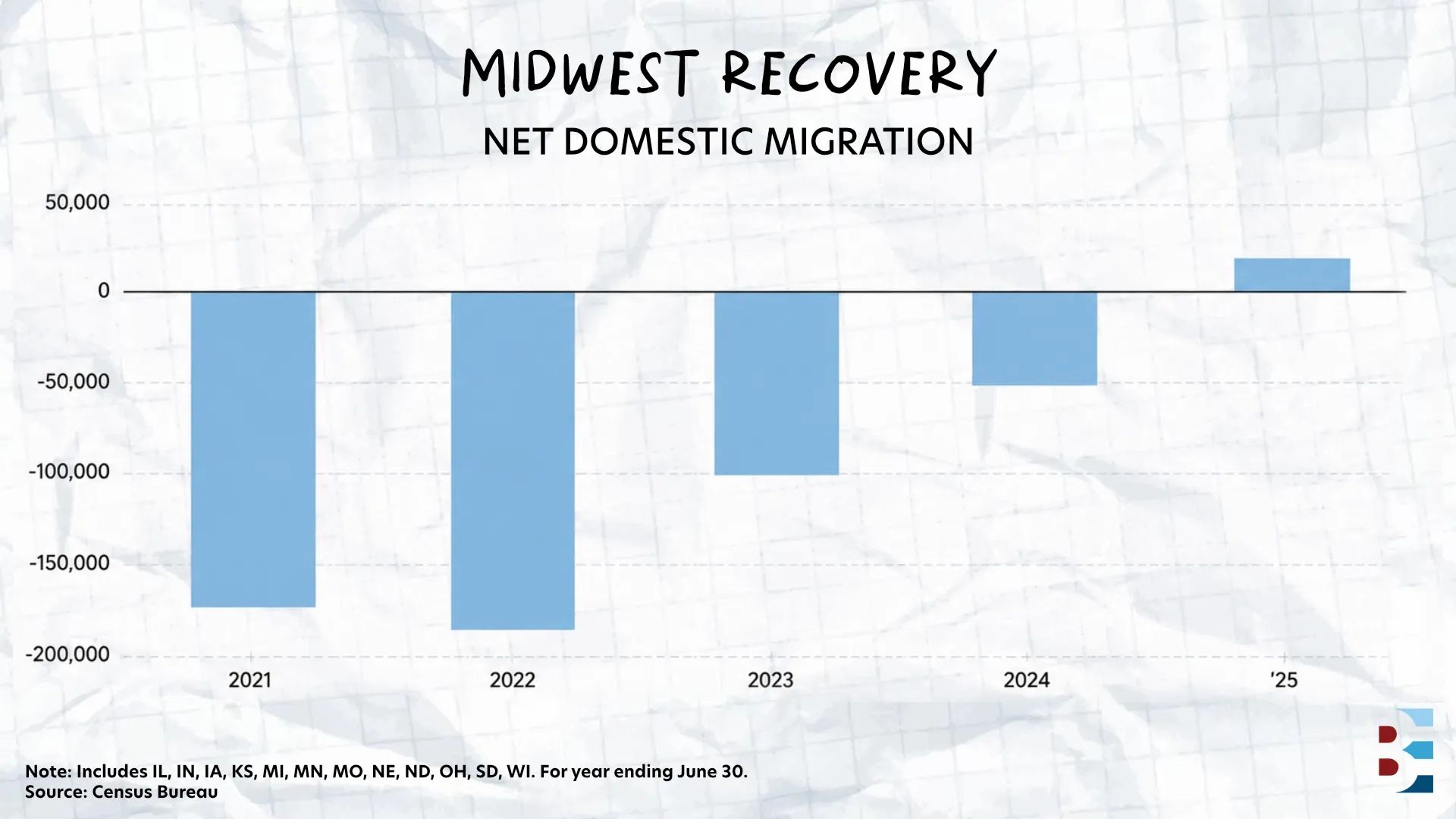
The narrative around the Midwest has been the same for decades: People left. They chased warmer winters, faster job markets, and cities that felt like they were building toward something. The Sun Belt absorbed them in droves, stealing the Midwest’s tax base, workforce, and housing demand with them.
That narrative is changing. A new Census analysis shows the Midwest gained a net 16,000 domestic migrants in the year ending last June — a modest number that carries outsized weight. As recently as 2022, the region was losing more than 175,000 residents annually to other parts of the country. The reversal is showing up in metros like Indianapolis, Columbus, and Des Moines, but also in places that had been written off entirely: Cleveland, Akron, Dayton, and Canton.
The forces driving it run in both directions:
The Sunbelt Slowdown: Job growth in Southern metros has cooled considerably since its post-pandemic peak, reducing one of the primary pulls that drew Midwesterners south for a generation. When the job delta narrows, the calculus on uprooting a family changes.
The Affordability Gap: Median home prices in the Akron and Cleveland metros sit at $226,000 and $237,400, respectively, roughly half the national median of $419,300. For workers priced out of Miami or Atlanta, markets once dismissed as flyover country are looking more like financial relief valves.
The Talent Retention Signal: At 22 universities across the Cleveland and Akron region, 52% of the class of 2024 stayed in the area after graduating, up from 47% just three years earlier. When graduates stop leaving, the demographic math begins to work differently.
The reinvestment is following the people. Abandoned industrial corridors are being converted to tech accelerators and residential units. Healthcare anchors like the Cleveland Clinic are drawing research talent from out of state. Office-to-residential conversions are adding housing stock in downtowns that spent decades shedding it.
None of this is a boom. Empty storefronts still dot stretches of Main Street in Akron. Cleveland has lost nearly 60% of its population since 1960, and the recovery is measured in thousands, not hundreds of thousands. But stabilization is its own signal — and in markets that have been declining for half a century, it tends to arrive before the opportunity is obvious.
Midwest markets have spent years trading at discounts that reflected outmigration risk. That risk is compressing. For operators and investors with buy boxes built around affordable basis, strong yield spreads, and limited new supply, the demographic risk that kept Midwest cap rates wide and prices low is starting to erode, and the window to buy ahead of that shift is narrowing.

In the current market, sophisticated investors recognize that "staying the course" often requires looking beyond traditional asset classes. QC Capital has built their reputation on institutional-grade underwriting and a dedicated focus on operational excellence. Today, they are applying that same disciplined framework to the express car wash sector.
The QC Capital Car Wash Fund offers a unique opportunity to diversify into membership and service-based retail. Targeting up to 12% returns alongside significant tax benefits, this fund bridges the gap between traditional real estate and high-velocity business operations.
Unlike passive assets, express car washes thrive on throughput and precision. They specialize in transforming these daily-need assets into scalable platforms by applying institutional-grade management and automated operations. They focus on brand architecture and data integrity, and they drive profitability where others see only a service business. Partner with an operator that prioritizes straight-talk transparency and operational excellence.
Discover how QC Capital is bridging the gap between sophisticated private equity and essential retail services.
EXPLORE FUND DETAILS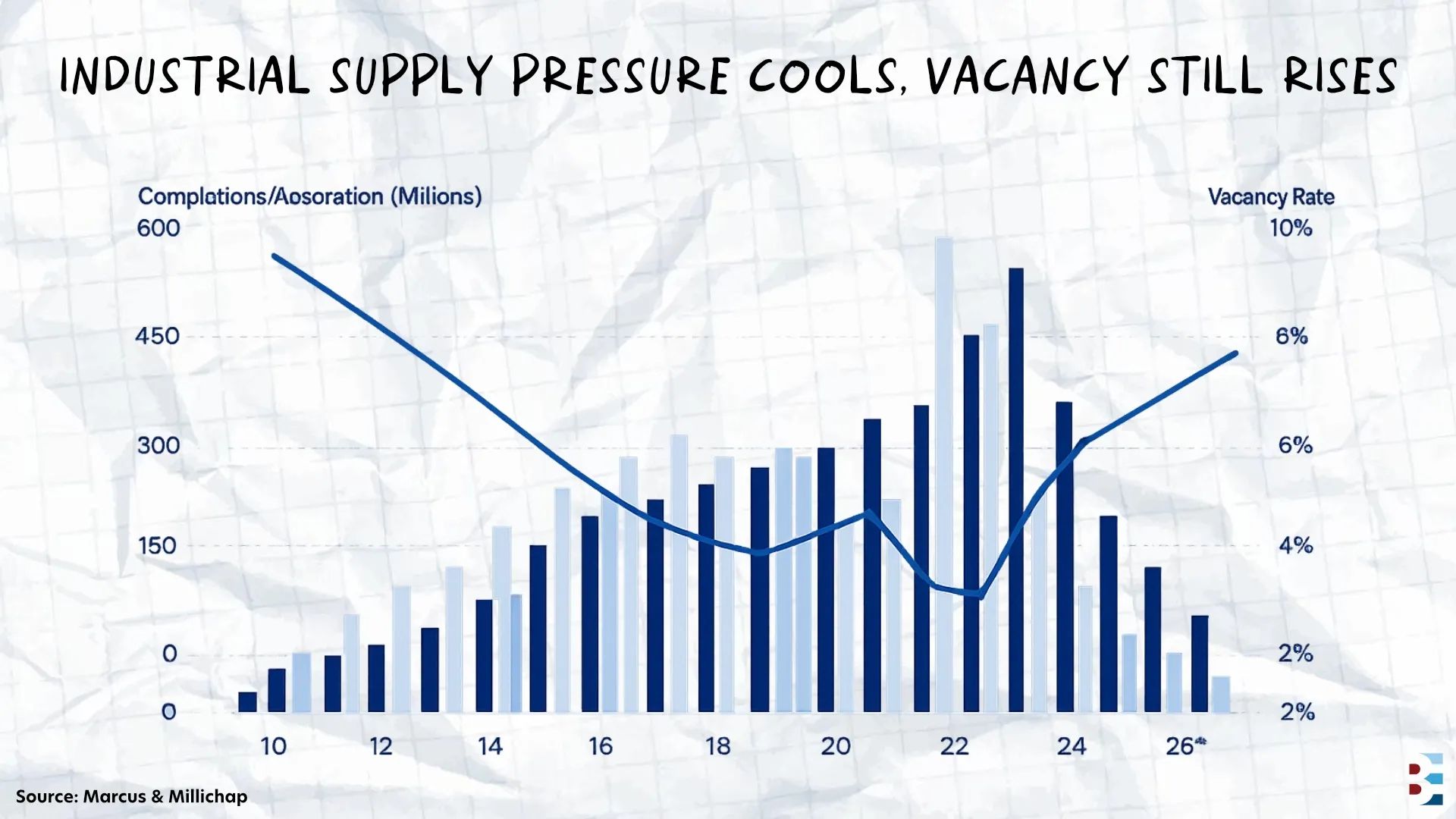
Industrial cap rates have edged down to 6.8% nationally even as vacancy climbs toward a projected 8.4% by year-end, with transaction volume over the past 12 months ranking second only to the 2021 peak. Investors appear to be looking past the supply overhang toward long-term e-commerce demand, with 2026 development running 64% below the 2023 peak.
Wild Stat: Infill warehouses under 50,000 SF are sitting at just 4.5% vacancy — less than half the rate of big-box properties between 200,000 and 750,000 SF, which stand at 11.1%.
Office investment sales reached $20.5 billion in Q1, a 38.6% jump YoY, as institutional investors returned to the sector after years on the sidelines. Year-to-date institutional purchases have nearly matched all of 2023's volume, with REITs also on pace to surpass last year's full-year total.
Private equity firms now own roughly 13% of all U.S. apartments — nearly three million units across 11,800 properties — with more than 45% of those acquired since 2021. Blackstone leads all owners with 230,000 units nationwide.
Outlier: Georgia has the highest private equity apartment ownership concentration in the country, with private equity firms owning roughly 31% of all apartment units statewide.
Nearly 40% of U.S. rental listings offered concessions this spring, a record high for the season and up five percentage points YoY, according to Zillow. Denver, Charlotte, and Dallas lead all markets at 68.3%, 66.6%, and 64.2%, respectively, as new supply has pushed the national vacancy rate to 7.3%.
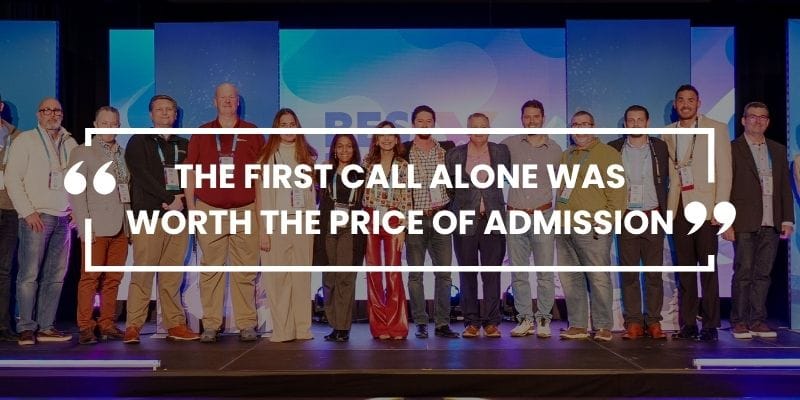
“The conversations are practical, honest, and high-level, not surface-level networking. Being able to workshop deals, capital raises, and partnership structure issues with experienced operators has been incredibly valuable.”
— Seth G., Founding Member
Inside recent Inner Circle discussions, members have been:
Negotiating lender pressure on struggling assets
Raising capital through RIAs and family office relationships
Structuring bridge debt and rescue financing
Using AI tools to improve underwriting and investor communication
Building systems to scale beyond the founder bottleneck
These are active operators solving real problems together in real time.
🗓️ Our first annual Inner Circle offsite is coming up on August 4th in Cincinnati (a full day of strategy sessions followed by an evening in a private suite at a Cincinnati Reds game), so now is a great time to join! Start building relationships before we meet in person.
LEARN MORE ABOUT THE INNER CIRCLE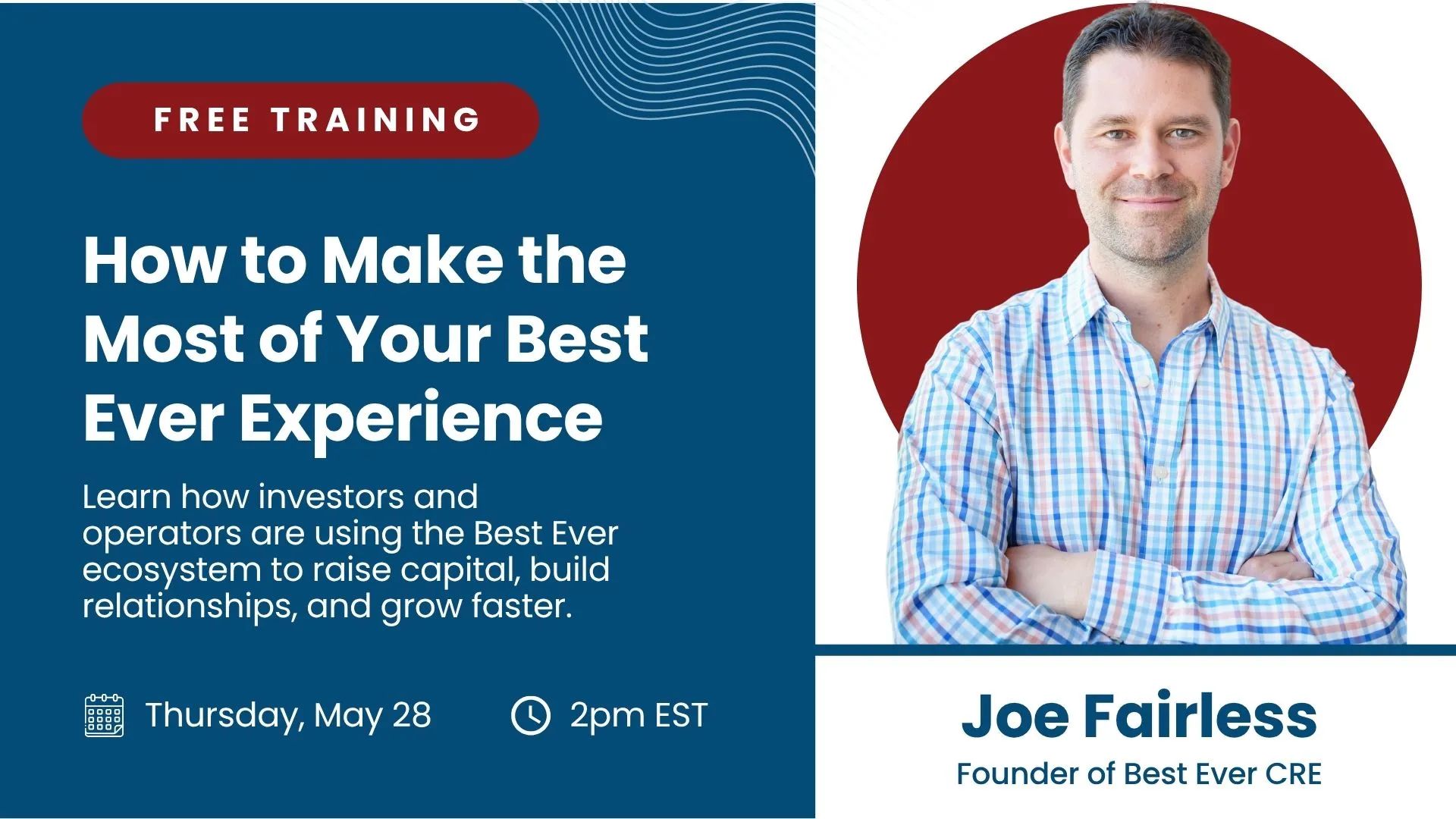
Today at 2 pm ET, Joe Fairless is hosting a free training on how to get more out of the Best Ever community.
He’s sharing real examples of how members are using best Ever Resources to raise capital, find deals, and build relationships that actually move the needle.
Here's what Joe will cover:
📌 How community members are using the Best Ever ecosystem to raise capital and build strategic partnerships
📌 Every resource available to you — and how to use each one effectively
📌 Real stories of members who are growing faster by plugging in more intentionally
📌 A clear roadmap for your next step inside the community
You'll leave with a clearer picture of how to make Best Ever work harder for you, whatever stage you're at.
REGISTER HERE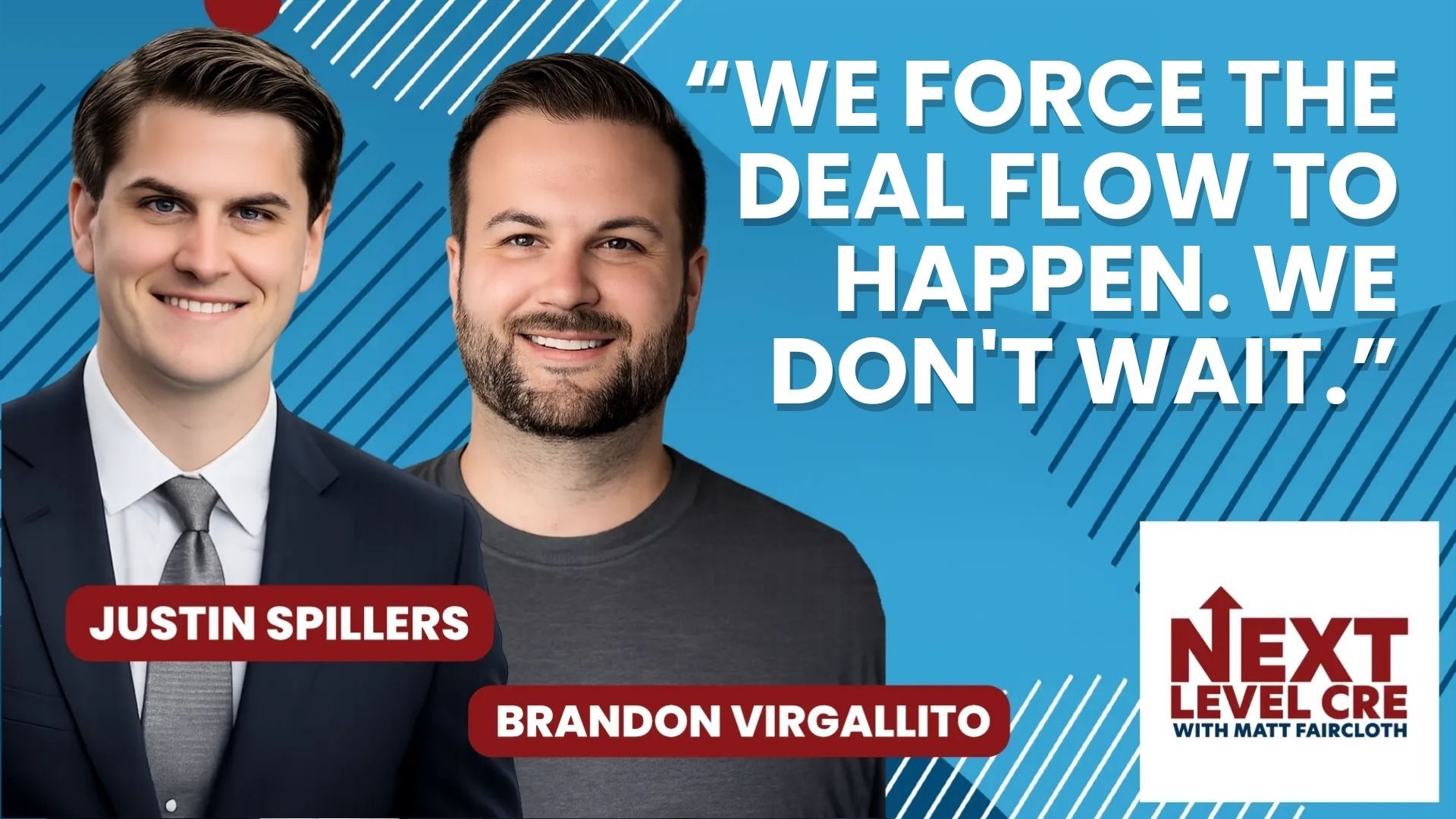
Somewhere right now, a multifamily operator is refreshing CoStar. Checking LoopNet. Scanning broker emails for something — anything — worth underwriting. Searching for diamonds on what has become the very deep rough. Justin Spillers and Brandon Virgallito, co-founders of Real Estate Alpha, decided that this isn’t a strategy. It’s hope.
This week on the Best Ever CRE Show, Justin and Brandon joined Matt Faircloth to break down the forced acquisition system they’ve built to generate consistent off-market deal flow in Ohio's multifamily market.
Their starting point is data, and the assumption that most of it is wrong. There are roughly 20,000 multifamily properties in Ohio. About 4,000 fit their buy box. And of those, Justin says, only about half have accurate ownership information available through commercial listing platforms. Their acquisitions team — a manager and two analysts — spends its days scrubbing Secretary of State filings, county websites, eviction records, and legal databases to surface what no one else has verified. That list becomes the target.
The Owner Channel: Six touchpoints per contact — cold calls, texts, email, direct mail, video mail, and a bottle of wine. The goal isn't to catch someone ready to sell today. It's to be the first call when a partnership dispute, a divorce, or an estate forces the conversation. "We force the deal flow to happen," Spillers says. "We don't wait for it."
The Broker Channel: They track 500 brokers. The top 50 send consistent deal flow and get weekly calls, gifts, and bottles of wine. The pitch is deliberate: send the ugly deals, the ones with bad financials or deferred maintenance. Real Estate Alpha will do the heavy lift, underwrite fast, put up 1% hard non-refundable earnest money, and always close. Brokers remember who makes their job easy.
The On-Market Channel: Roughly one-fifth of their volume. The other four-fifths comes from the first two channels — intentionally. "Rarely do we buy a property on market," Spillers says.
About 10% of their target list turns over every year through ownership changes, so the team runs continuous updates. A finite buy box is what makes the whole system possible — but it's the years of owner and broker relationships built around that box that turn outreach into a pipeline no listing service can replicate.
"We force the deal flow to happen," Spillers says. "We don't wait for it."
🎙️ Listen to Justin and Brandon’s full episode here.
🙏 Thanks for reading!
Stay in the loop with us! If you received this newsletter from someone else, subscribe here. You can also find us on LinkedIn, Instagram, and YouTube.
Have a Best Ever day!
— Joe Fairless