👋 Happy Sunday, Best Ever readers!
In today’s newsletter, concessions get risky, Trump threatens more tariffs, landlords sue, fundraising falls, coworking migrates, and much more.
📩 The replay is now available for Medical Receivables | The Asset Class That Doesn't Care What the Market Does, our free training from last week alongside Ironton Capital. Get the replay here.
🌟 The Inner Circle just got even better. We've added powerful new benefits to help you raise capital and strengthen operations. And we're just getting started. Join by July 31 to lock in current pricing for life, be part of everything launching next month, and secure one of only three July bonuses left. Schedule your intro call.
Let’s CRE!
🇨🇦 Tariff Threat: President Trump threatened 50% tariffs on most Canadian goods on July 20, which would take effect August 19 if the two countries don't reach a deal. Cement faces the biggest exposure, though Canada supplies only about 5% of U.S. cement production, so the impact on builders may stay limited.
🏙️ Landlords Sue: New York City landlords have sued to block Mayor Mamdani's rent freeze on one million stabilized apartments, alleging the Rent Guidelines Board manipulated data. The board's own figures showed costs up 5.3% and incomes up 6.2%.
🏦 Hard Money: Private real estate fundraising fell 38% to $92.6 billion in H1, the slowest first-half pace since 2017, as investors funnel capital to proven sponsors. Roughly 70% of funds still met or beat their targets.
🚒 Burning Bridges: A proposed EB-5 rule would tighten job-creation standards on bridge financing, the program's most popular source of capital, in a move one attorney warns could disqualify the majority of offerings now preparing to come to market. The rule is open for public comment through early September.
📦 Industrial Tightens: The industrial vacancy rate has dropped below 7% for the first time in years, hitting 6.9% in Q2 as leasing reached its highest level since mid-2022. Dallas/Fort Worth led with 40.3M SF of activity.
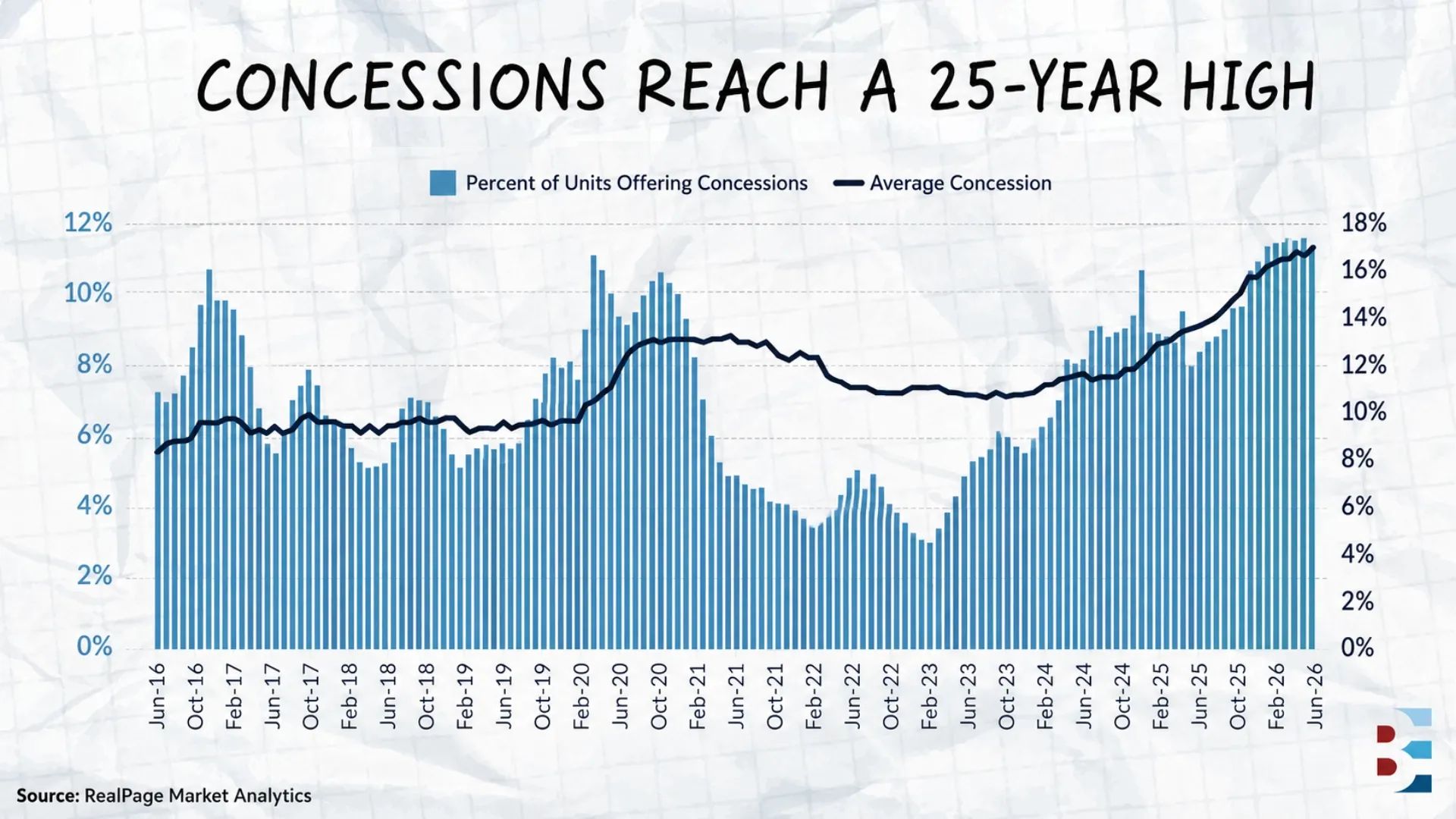
One month of free rent used to be enough to win a negotiation. Now, the deposit is being thrown in too, and the latter is quietly rewriting the risk on a property's balance sheet. And for owners fighting to hold occupancy in oversupplied markets, the exposure that comes with waiving deposits lands right as a wave of refinancings comes due.
The rent side is visible everywhere. The average U.S. concession reached 11.1% of annual rent in June, according to RealPage. That is the richest discount it has recorded in more than 25 years, and it equals nearly six weeks of free rent on a 12-month lease. Roughly two in five listings nationally advertised a concession that month, up from 35.2% a year earlier. Asking rents still rose 2.2% over the same period.
That last part is the catch. Advertised rents are going up. But after the free weeks owners are handing out, what they actually collect is barely moving. A property can report a rent increase and still take in less than it did a year ago. Charlotte, Denver, and Dallas all sit above 64% concession rates, the direct product of a Sun Belt building boom now working through its inventory.
The deposit side is where the real damage builds.
The Vanishing Deposit: The median deposit on hand has fallen to roughly $500. About 20% of leases now carry no deposit at all. When a resident moves out owing money, there is nothing held back to cover it. Those unpaid move-out balances now average $2,250, and CFPB data puts the median unpaid rental balance near $3,200.
The Renter Can't Cover It: The median renter holds about $1,800 in savings. Waiving the deposit does not get recovered later. The money is simply gone. The property is left chasing the balance through collections that hurt the renter's credit and rarely make the owner whole.
The Timing Problem: Roughly 13% of multifamily mortgages come due in 2026. Lenders refinancing those loans are looking hard at how a property actually performs. Unpaid rent and thin reserves land in exactly the numbers that decide whether a loan gets approved.
The pattern splits by asset class, which matters for anyone underwriting a deal. RealPage data shows Class C uses concessions most. One in five units offers a discount, as owners fight to fill units where renters are most stretched. Class A discounts the deepest, at 11.4% of rent, as new luxury buildings offer free rent to stand out while a wave of new supply hits at once.
These are two different problems at opposite ends of the market. They cluster in the same places: overbuilt Sun Belt and Mountain-Desert metros like Austin, San Antonio, and Denver. Metro New York and much of California barely discount at all.
Concessions are not going away any time soon. New supply is expected to slow through 2027 and 2028. But renters have gotten used to asking for deals, and the lost deposits do not come back when the free month ends. The way a property handles deposits and unpaid rent is now something lenders study at refinancing. It is no longer a leasing detail owners can treat as an afterthought. The free month fills a unit today. The waived deposit sends the bill down the road.

Over the last few months, we've invested heavily in the Best Ever Inner Circle to make sure members see it as an extension of their business, not just another networking group.
Here's what we’ve added to the Inner Circle membership over the last 30 days:
💰 Capital Raise Presentations — Present your deal to 15+ active fund managers looking to deploy capital.
⚖️ Legal Strategy Desk — Get direct access to an experienced commercial real estate and securities attorney for practical guidance.
🤖 AI for CRE Collective — Premium membership to the top AI community in commercial real estate with hands-on AI workshops, implementation guides, and workflows built specifically for CRE operators.
📊 Quarterly Underwriting Reviews — Get an independent review of one multifamily deal each quarter before your investors ever see it.
🛡️ Sponsor Background Checks — Reduce risk with an investigative review before partnering or investing.
And coming soon over the next 30 days:
🚀 Monthly Pitch Slam — Pitch your deal live to a panel of 7 experienced fund managers and RIAs looking to place $10M+, plus get exposure to the entire Best Ever Community of 52,000 investors.
📣 LinkedIn Authority System — Turn LinkedIn into a capital-raising tool with expert training, done-for-you content support, and authentic engagement from hundreds of real CRE professionals.
🏢 Distressed Deal Pipeline — Gain access to curated off-market distressed multifamily opportunities before they hit the broader market.
📍 Market Intelligence Platform — Compare markets using 60+ economic, demographic, and housing indicators to identify the strongest investment opportunities before underwriting a deal.
Because of these investments, membership pricing increases on August 1.
⏰ Don't want to miss the deadline?
You don't have to make a decision today. Simply schedule a call with AJ before August 1, and we'll honor today's membership pricing even if you join after the deadline.
SCHEDULE YOUR INTRO CALL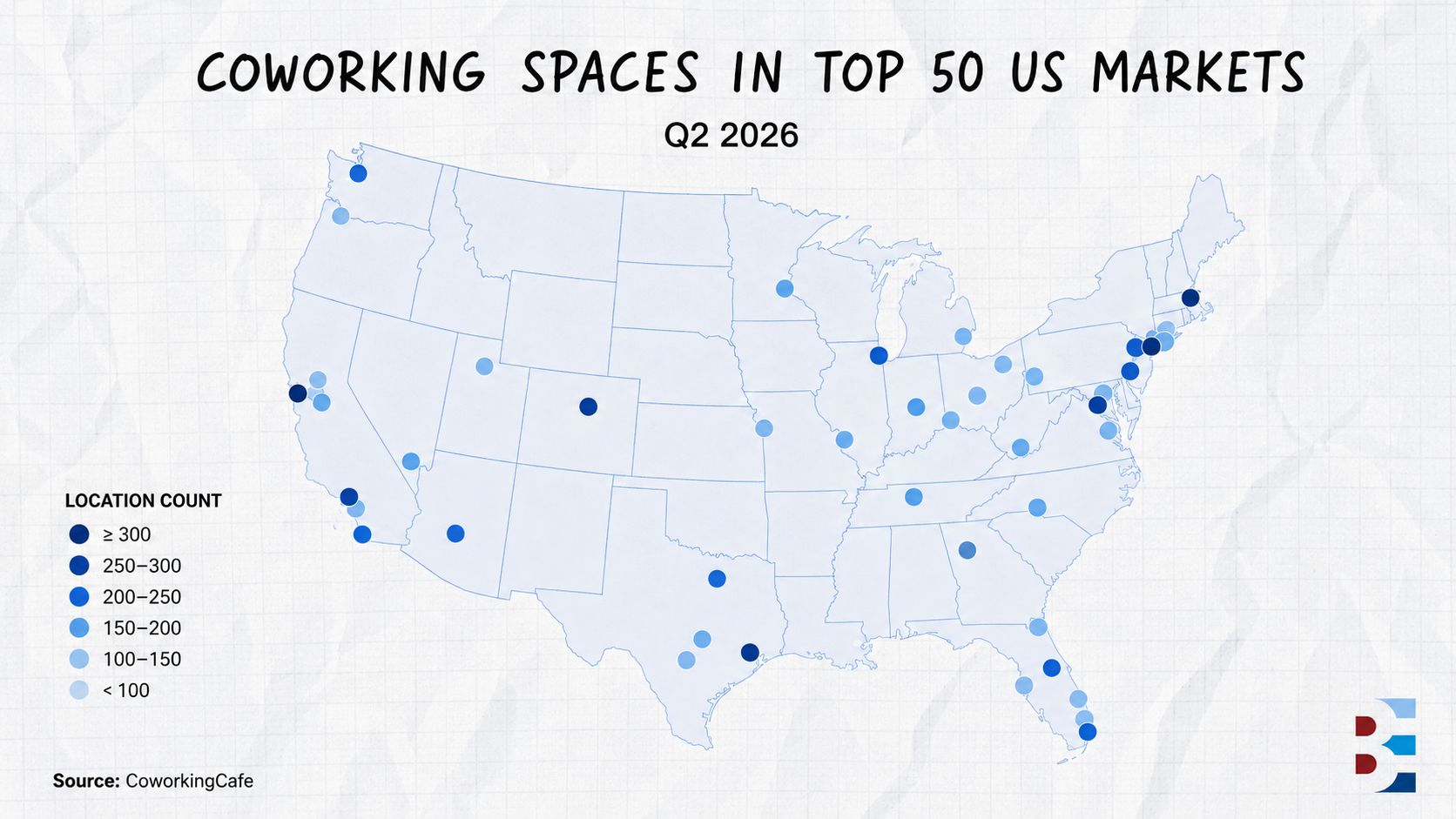
The coworking sector's growth has stopped looking like Manhattan and started looking like Indianapolis. Operators added 248 net locations in Q2, reaching 9,384 nationwide, and the momentum has moved decisively below the gateway metros.
Where the Growth Is: Los Angeles still leads on raw count but contracted 1%, while Chicago grew 3% to overtake Dallas-Fort Worth for second. Indianapolis jumped 14% past 100 locations, Salt Lake City posted one of the largest percentage gains nationally, and the South now holds more than a third of the top 50 markets.
Smaller Footprints: Location count rose 2.7% while total square footage grew only 1.5% to 166.36M SF, pulling average space size down to 17,728 SF. The sprawling floors that defined the last cycle are giving way to compact, localized sites.
Fragmented Ownership: Regus still runs 1,285 locations and HQ another 388, but independent operators now control more than three-quarters of U.S. flex offices.
Pricing held steady through all of it, with median membership slipping a dollar to $219, though Manhattan commands $339 against roughly $150 in Columbus and St. Louis.
Coworking now accounts for 2.3% of national office supply, up from 2.28% in Q1. The sector that overextended and retrenched after 2020 is rebuilding on a different footprint, defined less by trophy floors in coastal towers than by right-sized space in markets that never had much to begin with.

If you missed this week’s webinar, Ironton Capital's Lon Welsh walked through medical receivables from the ground up; how the asset class works, why returns come from insurance reimbursements rather than market conditions, and what to evaluate before adding it to your portfolio.
The core mechanic is straightforward: insurance companies are legally required to pay medical bills. When markets swing, the payments keep coming, and that structure has generated 11–13% annual returns for over a decade.
The replay is now live.
WATCH THE REPLAY
Cost segregation is table stakes for most operators at this point. But the difference between knowing the strategy and running it well is worth real money, and a few of the finer points still trip up even the most experienced buyers.
This week, Sean Graham and Chris Pierce of Maven Cost Segregation took over the Best Ever CRE Show to walk through where the leverage actually sits.
Used Components Reset Under New Ownership: When you acquire an existing asset, its components start fresh on their depreciation schedules regardless of the prior owner's basis or how long the building has stood. That's what lets a 2025 purchase of a decades-old building capture 100% bonus on its five- and 15-year components, as if they were new.
Condos Punch Above Their Weight: Because a condo often carries no ownership interest in the underlying land, there's little or no land value to strip out, so nearly the entire purchase price becomes depreciable basis. The lower the land allocation on any deal, the more you have to work with, and how that allocation gets substantiated is itself part of the study. Pair a condo with short-term rental treatment and the math gets interesting fast.
It's a Timing Play, Not a Tax Cut: A study doesn't manufacture new deductions. It moves them forward, pulling write-offs into the years your capital is tightest. In a market where equity is expensive and slow to raise, that's a financing lever as much as a tax one, and the freed-up cash goes straight into the next deal. On a $250,000 basis, Graham pegs the reclassification at roughly $75,000 into five- and 15-year lives.
How you actually put these losses to work — real estate professional status, the short-term rental rules, passive versus active treatment — is the ground Graham and Pierce take up across the rest of the takeover. Handled right, the payoff reaches past any single property.
"The tax benefits of owning real estate and being in real estate can be so significant," Graham says. "And not just from a real estate perspective. They can also help you offset all kinds of taxable income to the point where you can have a tax burden of nothing."
👉 For more cost seg strategies, listen to the full episode here.
🙏 Thanks for reading!
Stay in the loop with us! If you received this newsletter from someone else, subscribe here. You can also find us on LinkedIn, Instagram, and YouTube.
Have a Best Ever day!
— Joe Fairless