Together With

👋 Happy Sunday, Best Ever readers! We hope you are enjoying a safe Memorial Day weekend while remembering who and what we’re celebrating. 🇺🇸
In today’s newsletter, rent comes due, Providence reigns, renewal premiums surge, storage suffers, cap rates climb, and much more.
Today’s edition is presented by Malabar Hill Capital. While others chase the next trendy asset class, MHC executes one laser-focused strategy: building essential neighborhood retail where new Texans already live, shop, and spend. Learn more today.
💰 Inside the Best Ever Inner Circle this week, Trevor McGregor shared his “5 S’s” framework for improving execution and performing at a higher level in difficult markets. See the biggest takeaways below, along with details on our upcoming retreat in Cincinnati this August! Learn more.
Let’s CRE!
🏦 Rate Shift: Federal Reserve officials have moved from debating rate cuts to weighing hikes, with a majority signaling policy firming is appropriate if inflation stays above 2% amid Middle East energy disruptions.
🏛️ HUD Blueprint: HUD has released regulatory best practices for states and municipalities, encouraging capped permitting fees, by-right development, and AI-streamlined approvals to reduce construction costs.
📈 Cap Rate Climb: CRE cap rates have risen to roughly 6.3% from 5.2% in late 2021, with the spread versus 10-year Treasuries remaining historically tight, leaving room for further expansion if yields stay elevated.
🏗️ Storage Slowdown: Self-storage construction starts fell 29% YoY in Q1, with the under-construction pipeline down 14.5% annually as deferred and abandoned projects climb and new supply projected to slow materially through 2028.
🔑 Hottest Markets: Providence has claimed the No. 1 spot on Zillow's hottest summer rental markets list, with just 13% of listings offering concessions as national asking rents rise just 1.9% YoY.
The headlines on rent collection look like a recovery story. The fine print tells a more complicated one.
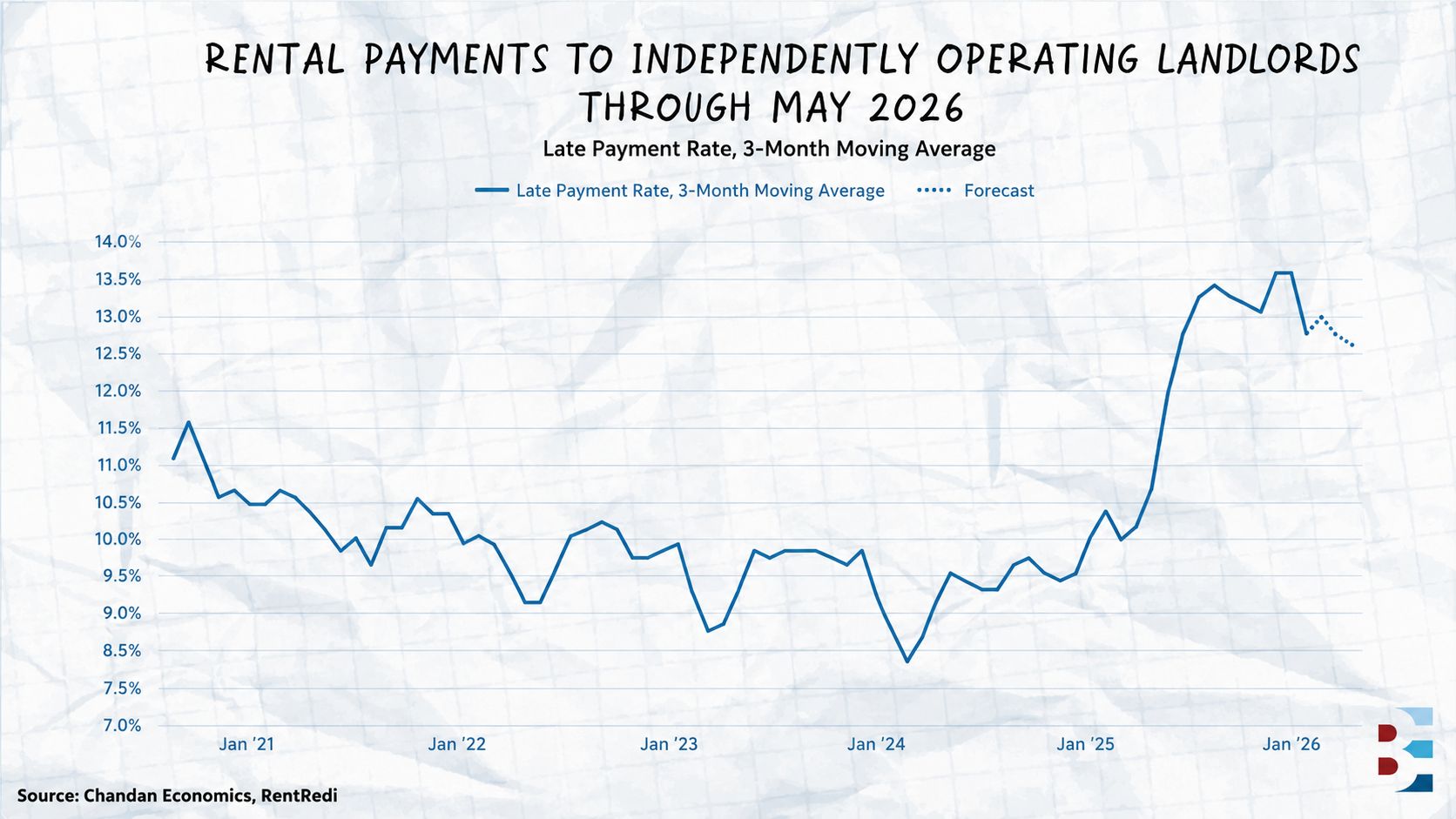
On-time payments across independently operated rental properties have climbed 223 bps since hitting their September 2025 low, and the forecast full-payment rate for May has reached 97.1%, the strongest projected outcome in a year.
But late payments — the number that actually dictates cash flow timing — are barely budging. After climbing from a cycle low of 8.4% to a post-cycle high of 13.5% in January and February, forecasts for March, April, and May came in at 12.7%, 12.9%, and 12.6%, respectively. The easing has slowed, but the level remains far above longer-run norms.
The distinction matters more than it might appear. Unlike institutional operators with reserves and credit facilities to bridge timing gaps, independent landlords depend on rent hitting on the first to cover mortgages, insurance, and maintenance. A tenant who pays late but pays in full looks fine in the annual numbers, but creates a cash flow problem every single month.
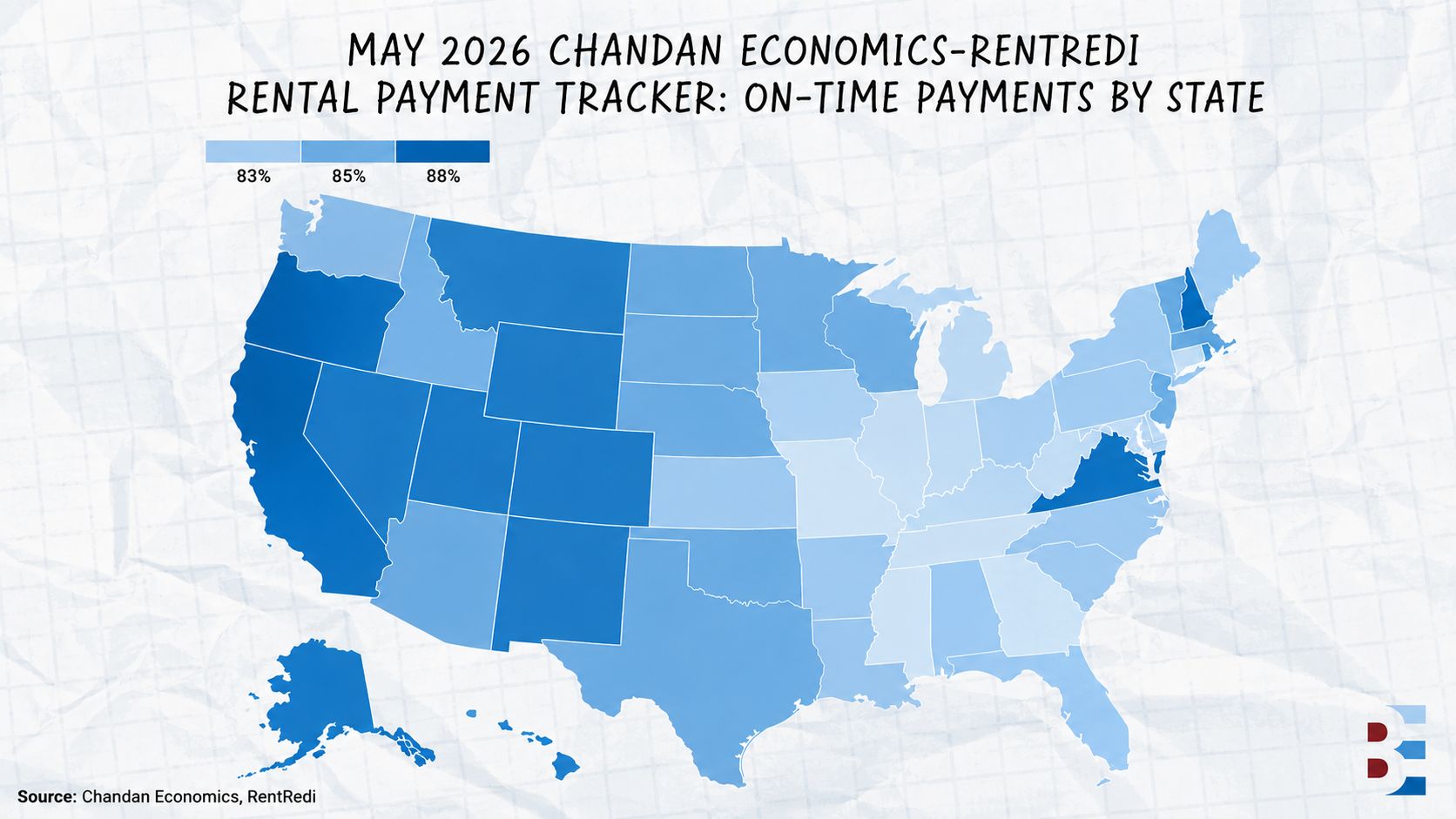
The Geography: Western and Mountain states lead the country, with Alaska, Hawaii, New Hampshire, D.C., and Colorado all posting on-time rates above 92%. Mississippi sits at 66.3%, with Michigan, West Virginia, Illinois, and Maryland all below 80%. That 27-point spread reflects differences in local economic conditions and renter income profiles that national averages obscure entirely.
The Macro Overhang: Signs of household financial strain were already visible before the recent run-up in energy prices. If energy-driven inflation persists through the summer, renter budgets absorb the hit first while late-payment rates, already stuck near cycle highs, have limited room to improve.
Property Type Divergence: Two-to-four-family rentals lead at 85.4% on-time, followed by single-family at 84.6%, with multifamily trailing at 83.3%. All three improved MoM, but multifamily is lagging the broader rebound.
Thirty-four consecutive months of YoY declines don't vanish because the direction has turned. The pace of deterioration has slowed, but the independent landlord segment is not operating in a normalized collection environment yet.
The late-payment rate is the number to watch. Full-payment resolution has improved, but cash flow timing risk remains elevated, and any reacceleration in household cost pressure could stall the progress that's taken most of the past eight months to build.

The Texas Triangle added over one million new residents last year. That growth creates immediate demand in communities where people already live.
Malabar Hill Capital develops ground-up neighborhood shopping centers inside new master-planned communities, anchored by service-oriented, triple-NNN tenants with long-term leases.
Their strategy is built on one principle: Eliminate variability at every stage.
They acquire commercially zoned land with infrastructure in place — no land speculation. They hit pre-leasing targets before construction — no spec builds. They merchant build — every project has a defined exit timeline.
The result: Low-variability developments, predictable exits, and target returns of approximately 2x over a 3-4 year cycle.
Key Highlights:
30+ active projects across the Texas Triangle
Triple-NNN national and regional tenants
Defined exit timelines
Malabar Hill Capital is currently accepting accredited investor inquiries for active offerings. To learn more, reach out to Durwesh Khalfe at durwesh@mhcapital.org or click below.
BOOK A DISCOVERY CALL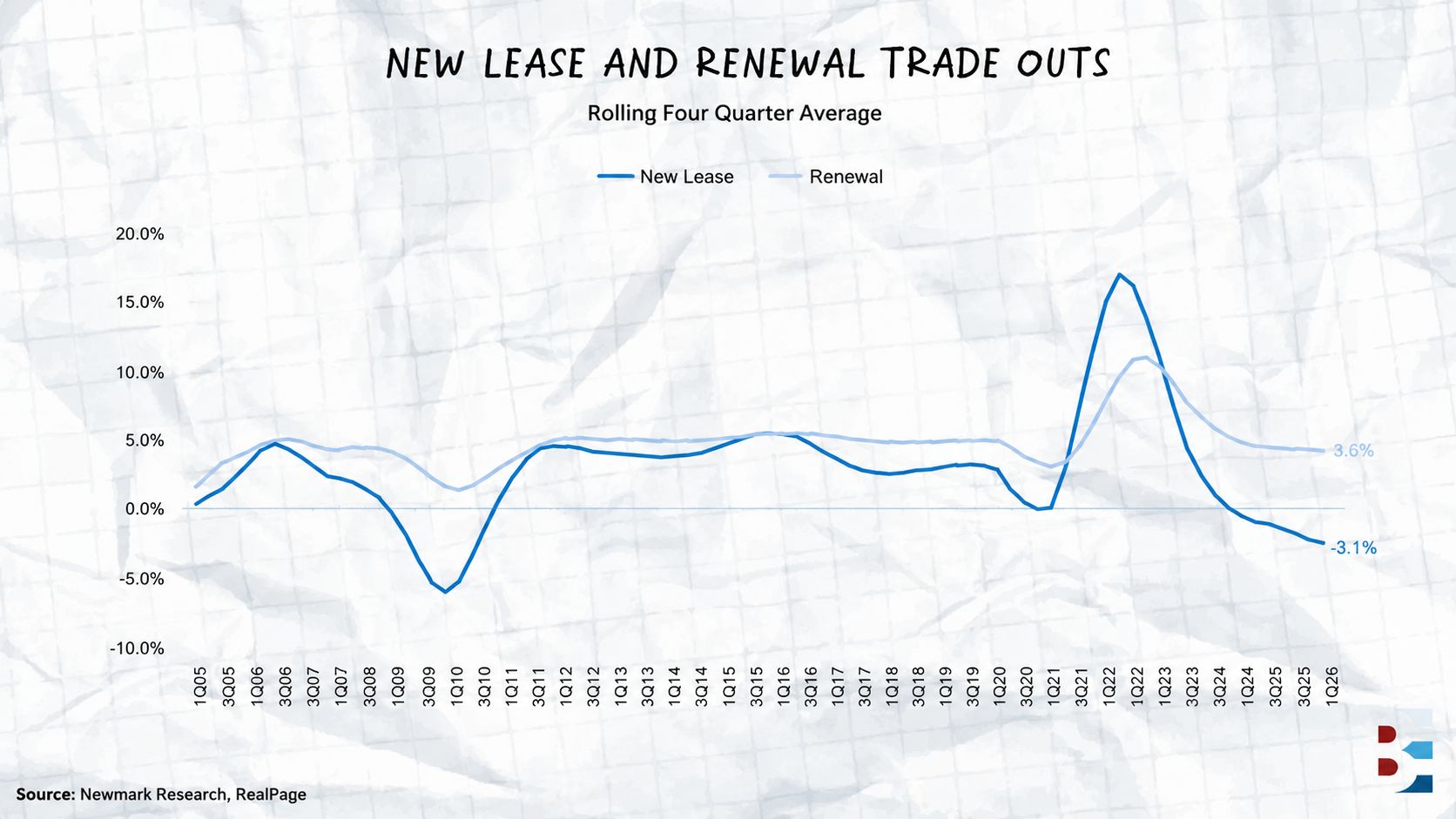
Renewal premiums don't usually make headlines, but the spread between what landlords are getting on renewals versus new leases has quietly reached a level not seen since 2009.
Renewal lease rate growth is outpacing new lease trade-outs by 6.7% on a rolling 12-month basis — with renewals running at +3.6% while new lease trade-outs have turned negative at -3.1%. That gap reflects a deliberate operator shift. Keeping a tenant in place has become meaningfully more valuable than attracting a new one, and the pricing bears that out.
The Retention Math: When new lease trade-outs turn negative, every vacancy carries a cost beyond just lost rent — it also means re-leasing into a market where the replacement tenant is paying less than the one who left. Operators who hold their residents are protecting both occupancy and effective rent simultaneously.
The Supply Overhang Effect: Concessions are rising across all asset classes — Class C units now see 31.1% of inventory offering concessions, with Class A and B not far behind at 21.4% and 23.8%, respectively. New lease pricing is absorbing that pressure. Renewals, insulated from direct competition, are not.
What Changes This: The renewal premium narrows when new supply decelerates enough to tighten vacancy and restore pricing power on new leases. Quarterly deliveries are already down 53% from their 3Q24 peak — that shift is underway, but has not yet worked through to new lease trade-out rates.
For operators underwriting acquisitions in the current environment, the renewal-to-new-lease spread is worth building into pro forma assumptions. Markets where new lease trade-outs remain deeply negative are markets where effective rent growth depends almost entirely on retention, and retention has limits.

This week inside the Best Ever Inner Circle, high-performance coach Trevor McGregor shared what he calls the “5 S’s” — a framework designed to help operators improve execution, avoid self-sabotage, and perform at a higher level in difficult markets.
Trevor’s core message was that success in commercial real estate is not just about tactics or mechanics. It’s about the mindset, habits, and internal standards driving your daily decisions.
The 5 S’s:
Self-Leadership — taking ownership instead of reacting to circumstances
State — controlling focus and energy because “where focus goes, energy flows”
Story — changing the internal narrative you tell yourself
Standards — raising the bar on what you expect from yourself
Strategy — continually reinventing based on performance and results
Trevor tied this directly back to the realities operators are facing right now — difficult capital raises, lender pressure, deal uncertainty, stalled growth, and investor hesitation.
The discussion sparked strong reactions from members afterward in the WhatsApp group:
“It’s amazing what mindset and reframing situations to work to your advantage have on your overall perspective on life.” — George M.
“I need to re-reverse some processes… forgetting to take care of myself first, and then never getting to it because other ‘more important’ things get in the way.” — Mark D.
💡 The takeaway: in a challenging market, the operators who win long-term are often the ones who can maintain clarity, consistency, and execution while everyone else becomes reactive.
🗓️ Our first annual Inner Circle offsite is coming up this August in Cincinnati—a full day of strategy sessions with fellow operators followed by an evening together in a private suite at the Cincinnati Reds game.
If you’re interested in joining the room and want to see whether the Inner Circle is a fit for you and your business, now is a great time to connect with our team. Click below.
LEARN MORE ABOUT THE INNER CIRCLE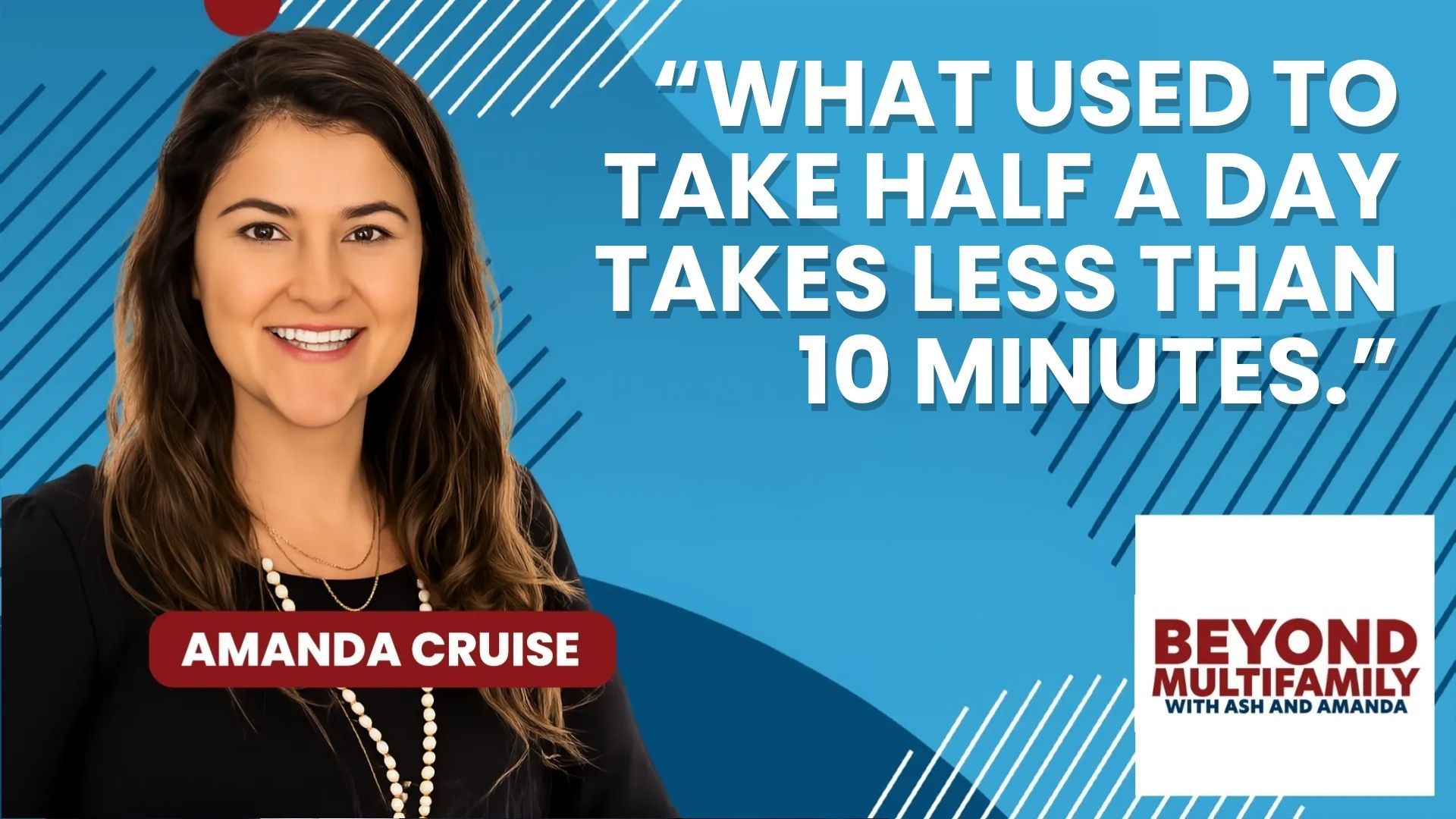
Every month, after closing the books, Amanda Cruise would spend half a day building investor updates, pulling from property management software, QuickBooks, last month's report, and manager notes. Manually. For every property.
Then she built an AI workflow, and the whole thing now takes under 10 minutes.
This week on the Best Ever CRE Show, Amanda broke down how she automated her back-office operations and what that actually looks like in practice.
The 10-Minute Investor Update: Amanda’s built a workflow in Claude Cowork that connects AppFolio, QuickBooks, and the previous month's Monday project management update into a single automated pipeline. The system reads across all three, assembles the monthly report, and shares a draft with her assistant to load directly into ActiveCampaign, ready to send. No manual data entry, no tab-switching, no half-day blocks.
The Five-Hour Employee: Amanda also built an AI transaction coordinator — an agent configured to run every hour and manage the handoffs her team couldn't staff efficiently. It pings the sales coordinator for applicant updates, tracks screening and background checks with her assistant, follows up on third-party financing, and flags anything stalled. It took about a day to build. The cost runs $200 a month — low because the platform runs on tokens, and a workflow humming in the background consumes less than one being actively built.
Skills as Institutional Memory: In Claude Cowork, a "skill" is a documented process turned into an executable instruction set — something the AI can run on its own. Amanda highlights that when a human employee leaves, their knowledge of how things work walks out with them. When that process lives as a skill, it stays. If her assistant left tomorrow, someone else could pick up and run the same workflow without rebuilding it from scratch.
The operators moving fastest right now aren't necessarily the ones with the biggest teams. Amanda's back office runs leaner than it did a year ago and costs less, because the parts that don't require a human no longer have one.
🎙️ Listen to Amanda’s full episode with Ash here.
🙏 Thanks for reading!
Stay in the loop with us! If you received this newsletter from someone else, subscribe here. You can also find us on LinkedIn, Instagram, and YouTube.
Have a Best Ever day!
— Joe Fairless