Together With

👋 Hello, Best Ever readers!
In today’s newsletter, conversions take over storage, Trump’s ban stalls, a housing bill passes, farms fold, and much more.
Today’s edition is presented by Tribevest. Many Sponsors want to work with Independent Capital Aggregators (ICAs) — fewer have a real Fund of Funds program behind it. Tribevest is meeting with Sponsors at the Best Ever Conference who want to turn ICA relationships into a repeatable, professional capital channel. Meet Tribevest at Best Ever.
Let’s CRE!
🏘️ Housing Bill: The House passed landmark bipartisan legislation 390-9 this week to accelerate housing development by streamlining permitting, modernizing zoning, and strengthening community banks. The Senate passed similar legislation last fall. The two chambers will reconcile bills in the coming weeks.
🚫 Trump Ban Stalls: After President Trump pushed for banning institutional investors from buying single-family homes, House Republicans blocked the amendment to avoid derailing bipartisan housing momentum. GOP lawmakers cite free-market concerns and lack of policy definition.
🏭 Industrial Surge: Clarion, Prologis, and Blackstone are accelerating acquisitions across logistics hubs. Clarion deployed $2 billion in modern warehouse assets in the past year, while Prologis posted record 2025 leasing. Demand concentrates in Los Angeles, Houston, and Phoenix.
🏥 Recovery Mode: Senior living investors expect cap rates to decline further through 2026 as valuations rebounded 10% YoY in 2025. Occupancy hit 90% by year-end 2025, the highest since 2017, driving Q4 transaction volume up 30% YoY.
📊 Holding Pattern: Commercial property values were flat in January but up 2.4% YoY through January 2026. Industrial leads at only 13% below its 2022 peak, while office trails at 35% below. Most sectors saw zero price movement month-to-month.

Over the past decade, adaptive reuse has become the fastest-growing segment of self-storage development. More than 108M SF of converted storage came online in just 10 years, and another 3.8M SF is currently under construction. Nationwide, conversions now account for roughly 10% of total U.S. storage supply — 179M SF spread across more than 2,500 facilities. In 32 markets, conversions are the only development happening.
The Sunbelt is emerging as a conversion hotbed, while the East Coast and Midwest — with older industrial stock and limited development land — are converting at scale. Capital is flowing into specific underserved markets where ground-up development faces zoning constraints or land scarcity.
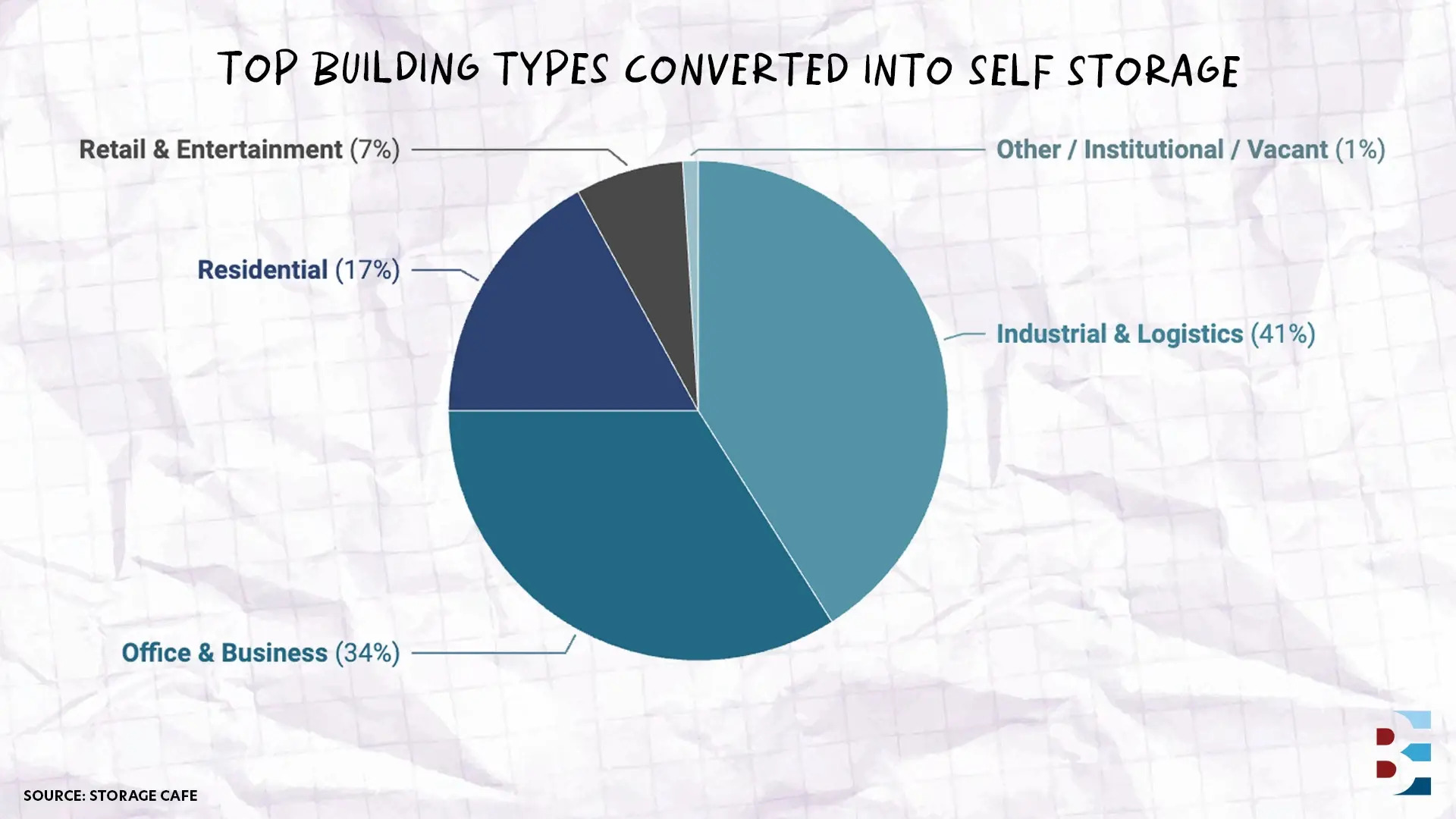
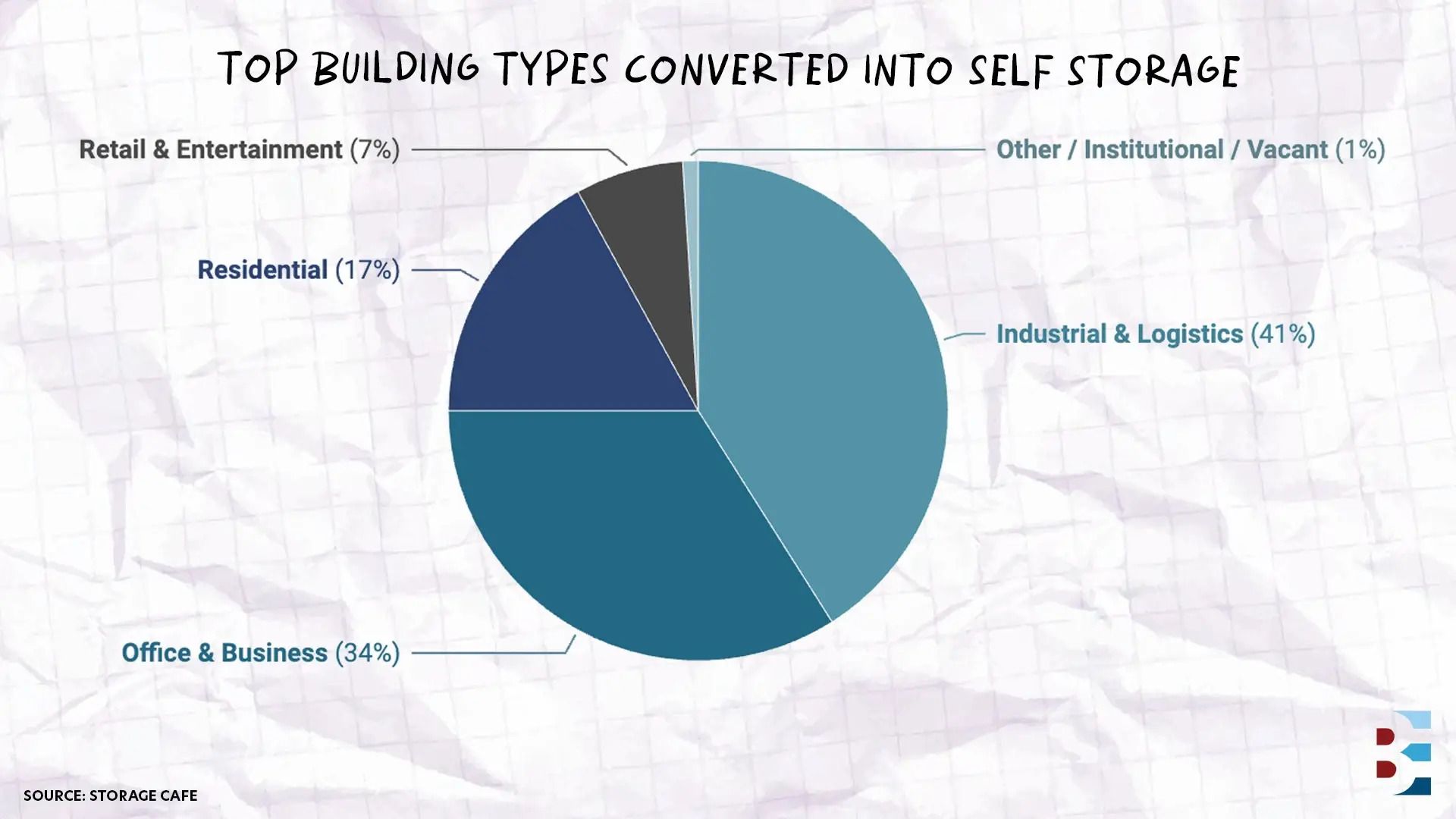
Industrial buildings dominate at 41% of conversions, followed by office space (34%) and retail (7%, though rising). In Irving, Texas, 95% of converted inventory comes from former retail. In L.A., office conversions lead as corporate relocations freed up hundreds of thousands of square feet ready for repositioning.
Pipeline Leader: Irving, TX leads with 233,000 SF under construction (80% conversions), adding to 213,000 SF of existing converted stock. Despite strong demand and 7% population growth, the market maintains 6.8 SF per capita supply.
Tier Two Momentum: L.A., Cranston, RI, and Fairfield, AL each have 200,000+ SF in the pipeline. Every L.A. conversion is located in an opportunity zone, part of a broader trend: 20% of all conversion projects nationally sit in federally designated opportunity zones.
Conversion-Dominant Markets: Buffalo, NY has 522,000 SF of converted inventory — over 60% of total supply. Philadelphia ranks third nationally for conversion inventory at 2.3M SF.
Secondary Growth Markets: Newport News, VA; Albany, NY; Little Rock, AR; Kentwood, MI; and Philadelphia, PA each add 110,000 — 175,000 SF under construction.
Converted units command lower rents initially — renting 7%-17% below newly built facilities — but they require significantly less capital upfront than ground-up development. Conversion costs are 40-60% lower than new construction, making target returns achievable despite lower rents. In markets like Buffalo, Albany, and Cranston — where conversions represent 60%+ of the pipeline — this is often the only viable path to deployment.
Conversions reveal where supply is actually constrained and where existing operators gain pricing power. In markets where conversions dominate the pipeline — Buffalo, Albany, Cranston — the scarcity of truly new supply is real, not speculative. This is market-by-market intelligence showing investors where to hunt for cap rate spreads and supply-driven upside.

Sponsors are increasingly turning to Independent Capital Aggregators (ICAs) for capital — but without structure, those relationships don’t scale.
Tribevest helps Sponsors design and run Fund of Funds programs that make it easy for ICAs to raise capital compliantly while protecting investor experience and sponsor reputation. They’ve worked with Sponsors who have raised $50M+ through their programs. They handle the infrastructure so you can focus on deals, execution, and relationships.
At the Best Ever Conference, Tribevest is offering:
Live demos of our new platform
Real examples of Sponsor-led FoF programs
Guidance on working with ICAs at scale
FREE deal pages to help showcase your active deals to ICAs and their investors
If you’re building (or refining) a FoF program, connect with Tribevest in person.
BOOK A MEETING WITH TRIBEVEST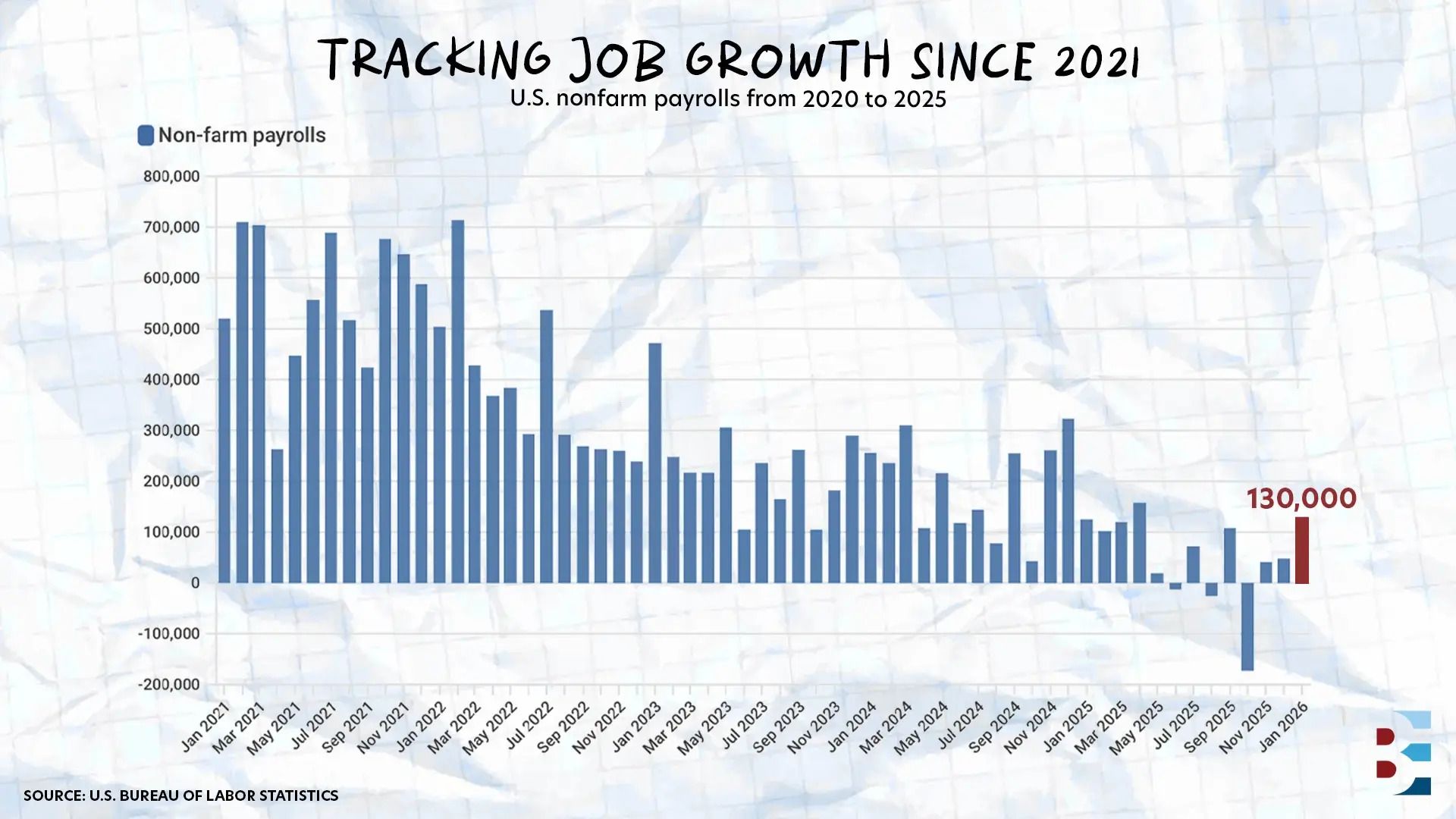
U.S. employers added 130,000 jobs in January, beating expectations after a weak 2025. However, an annual revision showed hiring last year averaged just 15,000 jobs monthly — nearly 900,000 fewer positions than originally counted. The unemployment rate dipped to 4.3%.
U.S. investment sales totaled $472.6 billion in 2025, up 19.9% YoY through the end of the year. Dallas-Fort Worth, San Francisco/Bay Area, Los Angeles, and New York led activity, collectively capturing 41.5% of deals. The top 12 markets continue to drive national performance as deal flow accelerates into 2026.
Farm bankruptcies jumped 46% to 315 Chapter 12 filings in 2025, the second consecutive year of increases. The Midwest and Southeast accounted for 226 filings combined, driven by deep crop losses across commodities and rising input costs. Total farm debt is projected to reach a record $624.7 billion in 2026.
CRE debt maturities are projected to drop 9% YoY to $875 billion in 2026 as the wave of refinancing pressures recedes. Lenders are expected to originate $805 billion in new commercial mortgages this year, up 27% YoY, with multifamily lending projected at $399 billion—a 21% increase.
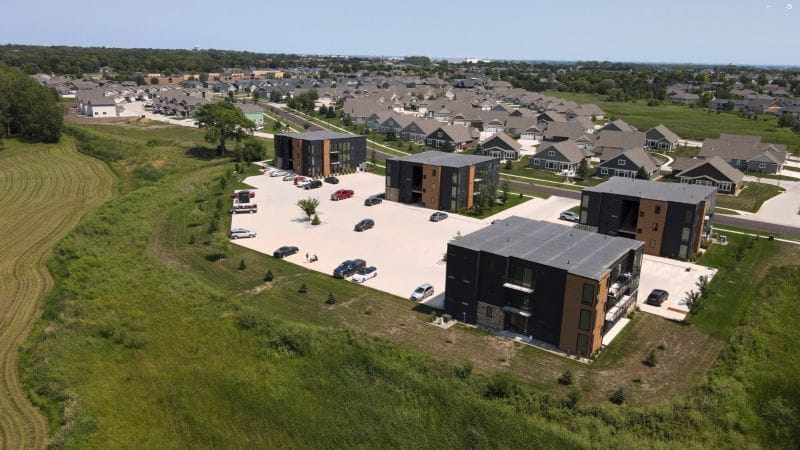
Dusten Hendrickson and the team at Mailbox Money RE have developed this workforce housing project in Brookings, SD, and are targeting a 20% IRR with a 2x equity multiple through a modern, high-density design built specifically for young professionals.
Here's how they're doing it 👇
🏢 Property details: The property consists of 48 total units spread across four buildings located in Brookings, SD. The project broke ground in March 2021 with a total development cost of approximately $8.2 million and is currently 90% occupied.
💸 Finances: The team raised $1,533,281 in capital. They secured a $6,133,123 construction loan at approximately 4% interest with 30-year amortization and 24 months interest-only.
💼 Business plan: The vision was to develop modern workforce housing for young professionals while delivering strong returns for investors. The design features Scandinavian interiors, minimal common space, small footprint, high density, surface parking, high-ROI amenities, and floor-to-ceiling windows.
Development Timeline:
9-12 Months: Deliver the first occupied building, with each additional building coming online in 1-2 month increments.
12-24 Months: Achieve cash flow and initiate dividend distributions.
24-48 Months: Complete the first refinance event.
48-120 Months: Execute the sale of property with opportunities to 1031 exchange into another project and defer taxes.
The property is currently cash flowing and the team is planning to refinance in late 2026.
🍾 Results: The projected returns for investors are:
7% preferred return
20% IRR
2X equity multiple
8% cash-on-cash
💪 Biggest Challenge: "The city caught an error in the plans after the foundations were poured, and they made us use the same foundation but change the floor plan to fit the model," said Hendrickson. "But we found we were able to expand to four buildings versus three after a redesign, which ended up penciling better and gave us better returns."
👉 If you have a deal you'd like to share with us, please email us here.
🙏 Thanks for reading!
Stay in the loop with us! If you received this newsletter from someone else, subscribe here. You can also find us on LinkedIn, Instagram, and YouTube.
Have a Best Ever day!
— Joe Fairless