


Taylor Swift and Travis Kelce aren't the only big thing happening in Kansas City in 2025. The Heart of America's commercial real estate market is separating itself from the pack, enjoying genuine momentum backed by solid fundamentals.
While coastal cities work through oversupply and pricing corrections, Kansas City is delivering the metrics that matter — $2.7 billion in trailing 12-month transaction volume, record corporate relocations, and cap rates that actually make sense for investors.
It's why the Heart of America is proving to be less of a tourism slogan and more of a legitimate investment thesis.
Market Highlights
- Industrial: 7.5M SF positive net absorption in Q1 2025 (second-highest quarterly total in market history)
- Office: 432,000 SF positive net absorption in H1 2025, defying national trends
- Multifamily: 96.4% occupancy with 4% rent growth (second highest nationally)
- Retail: 95.9% occupancy with 2.3% YoY rent growth, outperforming regional and national benchmarks
The Corporate Migration Story
The big news isn't just about square footage — it's about who's moving in and why they're staying. Pfizer committed $175 million for 425,000 SF and 2,000 jobs, marking the largest office recruitment in the region's history. Panasonic built a $4 billion EV battery plant, creating 8,000 total jobs. Google and Meta are investing $1.8 billion in data centers.
Logan Freeman, one of the Midwest's top CRE brokers, sees this as more than typical corporate cost-cutting.
"These aren't just local plays," he said on the Best Ever CRE Show in August. "These are global companies making billion-dollar bets on Kansas City's future."
Fiserv Inc. also announced it will open a new regional headquarters on the Aspiria campus in Overland Park, KS. The company will occupy approximately 427,000 SF and plans to have 2,000 employees at the site by March 2030.
Market Performance by Sector
Industrial: The Demand Engine
The industrial sector continues its hot streak, with Johnson County leading absorption at 4M SF. More telling, 85.8% of delivered space in 2025 has been built-to-suit projects, indicating genuine user demand rather than speculative development.
Key Metrics:
- Vacancy rate: 6.1%
- Asking rents: $5.72 PSF
- YTD net absorption: 7.7M SF
- Under construction: 7.4M SF
Office: Swimming Against the Current
While national office markets struggle, Kansas City posted three consecutive quarters of positive absorption. Freeman sees opportunity where others see risk: "The investors are saying, 'Okay, replacement costs may be $300, $400 for something like this. I'm able to get in at $60, $70, $80 a foot. In 10 years, can I [repurpose] this project to something else?'"
Key Metrics:
- Vacancy rate: 18.3% (down from 19.0% YoY)
- Asking lease rates: $23.25 PSF (up 1.2% YoY)
- Q2 net absorption: 117,375 SF (third consecutive positive quarter)
- Class A asking rates: $25.89 PSF
Multifamily: Steady as She Goes
The multifamily market demonstrates healthy fundamentals without the speculative excess seen in other markets. Central Kansas City leads with 938 units of net absorption, while 4,547 units remain under construction.
Key Metrics:
- Vacancy rate: 3.6%
- Effective rents: $1.50 PSF
- YoY rent growth: 5.0%
- YTD net absorption: 3,656 units vs. 2,200 delivered
Retail: Strong Fundamentals Drive Performance
Kansas City's retail market continues to outperform regional and national benchmarks, with robust leasing velocity across both national brands and local operators. The market shows particular strength in core infill areas and community shopping centers, with sustained investment activity reflecting investor confidence.
Notable retail developments include the Olathe Gateway Project — a $338 million mixed-use development featuring Michael's Wonder World theme park and 67,000 SF of restaurant/retail space — and the Merriam Grand State Marketplace, a $102 million development anchored by Trader Joe's, the first grocer in Merriam since 2018.
Key Metrics:
- Occupancy rate: 95.9% (4.1% vacancy)
- Average asking rent: $14.91 PSF (up 2.3% YoY)
- Investment volume: $520 million over the past 12 months
- Leasing activity exceeded new deliveries 6-to-1
Infrastructure Investment: Building the Future
Kansas City isn't just promising infrastructure improvements — it's completing them. Current major projects include:
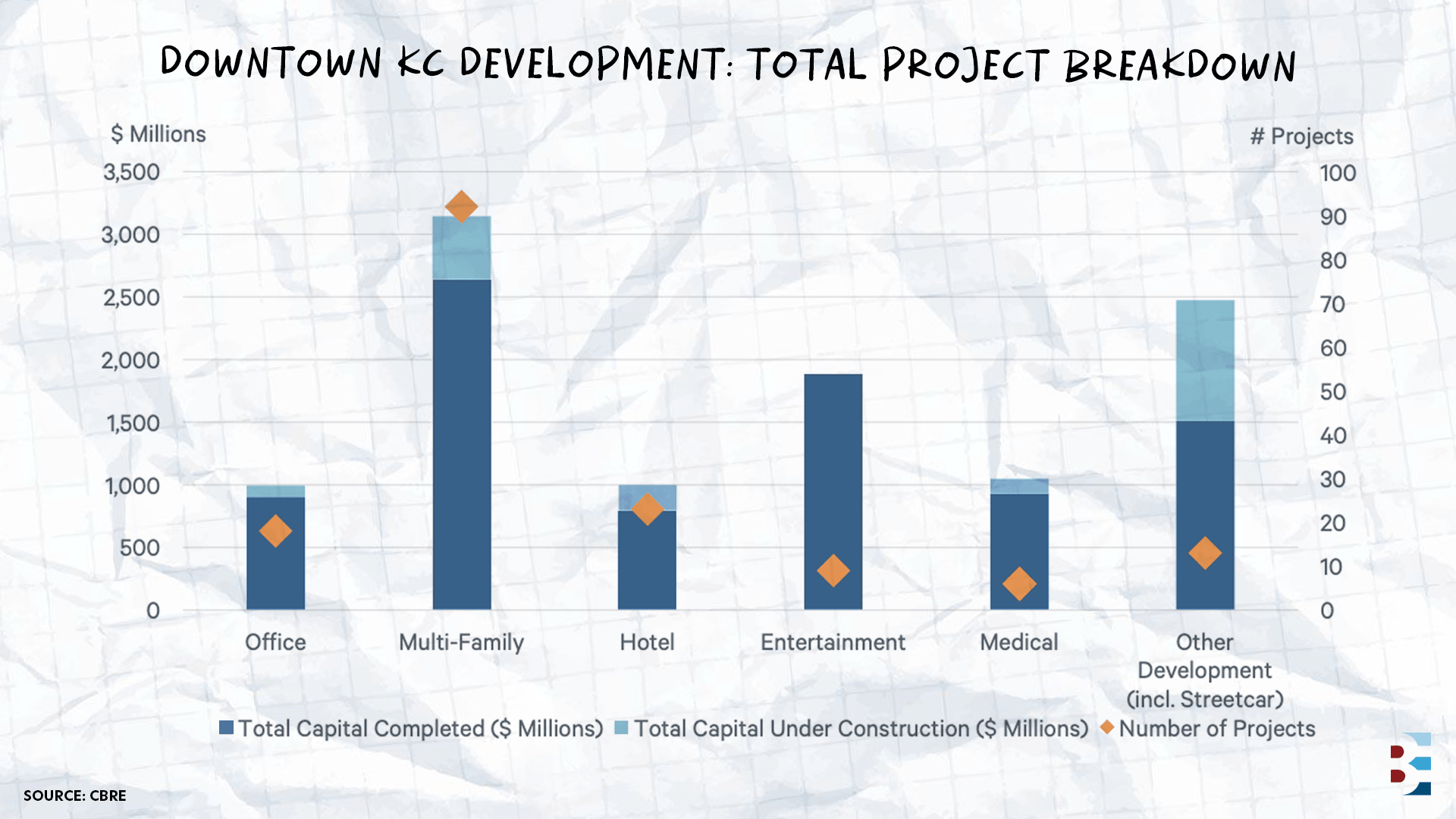
- $6.3 billion across eight major developments under construction
- $351 million streetcar extension (completion 2025)
- $334 million in downtown public space investments
- $527 million Samara Road investment in West Bottoms transformation
Downtown has experienced 88% population growth since 2010, supported by over $3 billion in completed development over the past five years.
Cap Rate Environment
Average cap rates increased 98 bps to 7.1% in Q1 2025, reflecting more realistic pricing rather than weakening fundamentals:
- Multifamily: 6.0% cap rates
- Retail: 7.1% cap rates
- Industrial: 7.6% cap rates
- Office: 8.4% cap rates
For investors accustomed to compressed cap rates in primary markets, Kansas City offers genuine value with room for appreciation.
Economic Fundamentals
The Kansas City metro's economic stability comes from genuine diversification:
- Population growth: 25,000 annually
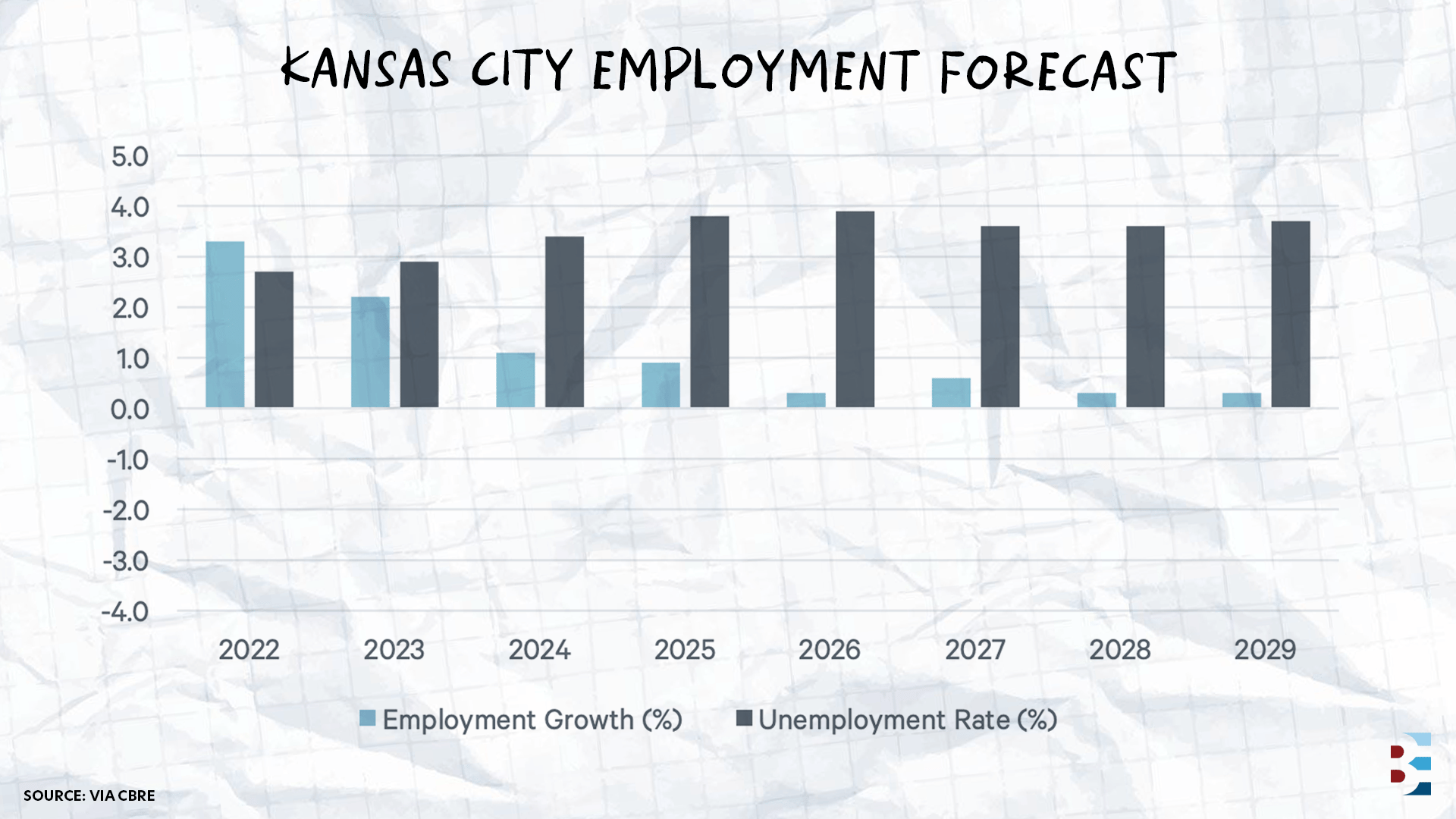
- Unemployment: 5.3% vs. 6% nationally
- Historical stability: 3.8% average unemployment (2016-2024)
- Education: 87,000+ students in four-year colleges
- Geography: Reach 80% of the continental U.S. within a two-day truck drive
Development Pipeline
The construction pipeline reflects measured growth rather than speculative excess:
Major Multifamily Projects:
- Arrive KC: 360 units (Central Kansas City, 2026)
- Oberon: 281 units (Central Kansas City, 2026)
- Alto Apartments: 280 units (Shawnee/Lenexa/Mission, 2025)
Downtown Developments:
- The Helm: 232 apartments (completed 2025)
- Wonderland Apartments: 215 units (2025)
- Grand Place: 250,000+ SF mixed-use (2026)
Major Retail Transactions:
- Sprouts Farmers Market (Lenexa): 86,280 SF sold for $11.5M ($133/SF)
- Liberty Commons Buildings: Multiple sales ranging from $232-$411/SF
- Chipotle (Independence): 2,330 SF sold for $3.125M ($1,341/SF)
Investment Outlook
Strengths:
- Diverse economic base provides recession resistance
- Major infrastructure investments are completing (not stalling)
- Corporate commitments represent genuine long-term bets
- Cap rates offer value with appreciation potential
- Geographic advantages for logistics and distribution
- Retail market showing resilience with strong occupancy and rent growth
What to Watch:
- Office market is still finding equilibrium
- Development costs are elevated but stabilizing
- Some construction timeline delays continue
- Retail sector is facing potential tariff-induced cost pressures on merchandise
Freeman's assessment captures the reality of the market's momentum.
"I don't think that Kansas City's the next big thing," he says. "I think we're the right thing happening right now. While everyone else is hoping for markets to come back, Kansas City never left. We're delivering today what other markets are promising tomorrow."
Sources:
Kansas City Commercial Real Estate Market Report Q2 2025, Newmark Zimmer Kansas City Retail Report Q2 2025, CBRE Kansas City Office Q2 2025, Cushman & Wakefield Kansas City Industrial Q2 2025, Cushman & Wakefield Kansas City Office Q2 2025, Cushman & Wakefield Kansas City Multifamily Q2 2025, CBRE Downtown Kansas City Development Report, Best Ever CRE Show interview with Logan Freeman
Disclaimer:
The views and opinions expressed in this blog post are provided for informational purposes only and should not be construed as an offer to buy or sell any securities or to make or consider any investment or course of action.